
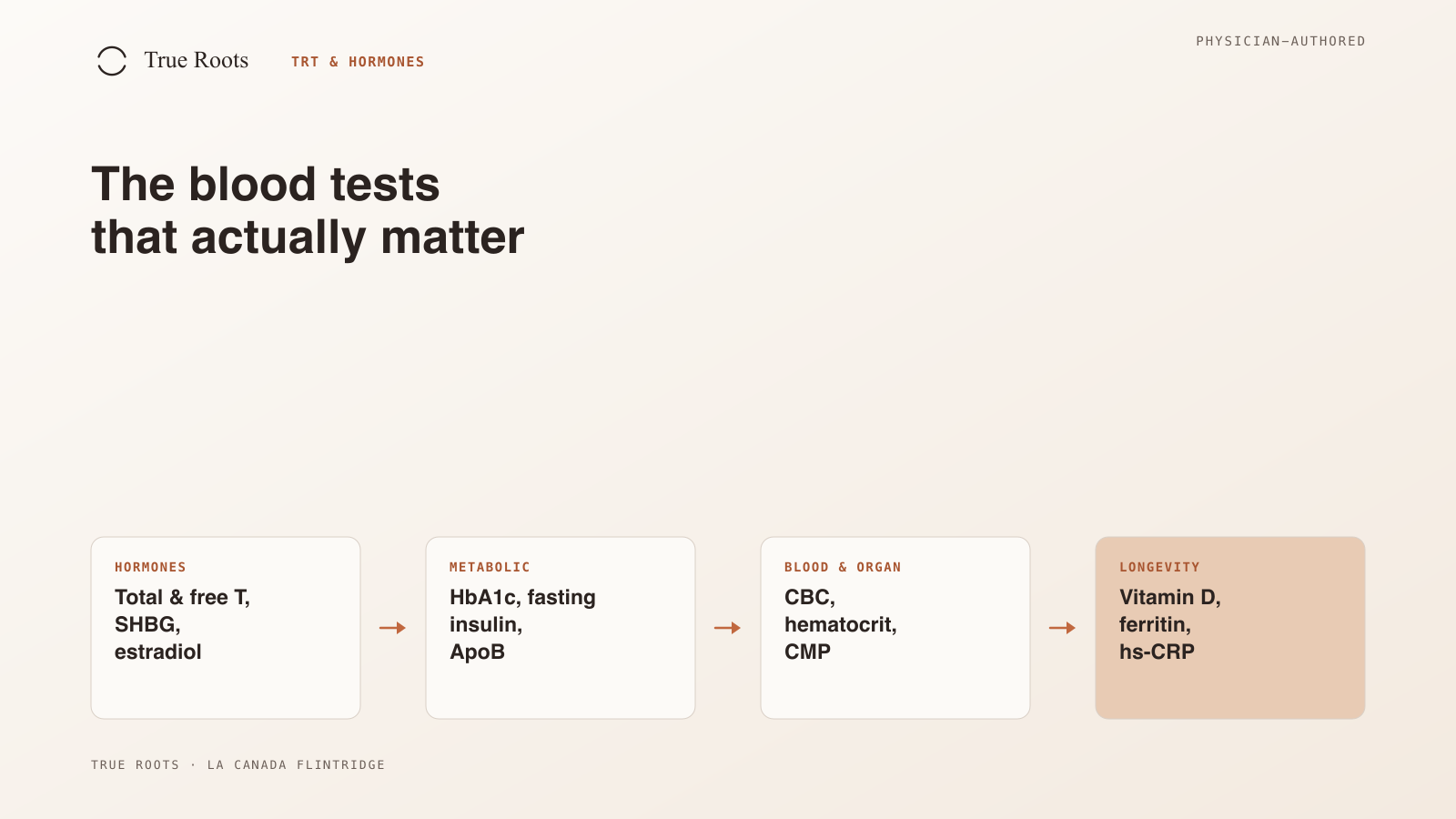
The blood tests that matter most for a man fall into four groups: hormones (total and free testosterone, SHBG, estradiol, LH and FSH), metabolic markers (HbA1c, fasting insulin, lipids with ApoB), blood and organ panels (CBC with hematocrit, CMP), and longevity markers (vitamin D, ferritin, hs-CRP, PSA by age). No single number tells the whole story, so a physician reads them together. At True Roots in La Canada Flintridge, near Pasadena and Glendale, a standard visit with Dr. Valle is $250, standalone and never credited, with lab work priced separately based on the markers you need.
Which blood tests actually matter for men?
Start with the four categories above rather than a scattershot of single tests, because the point is to see how the systems interact, not to collect numbers. Hormones explain energy, libido, mood, and body composition. Metabolic markers catch insulin resistance years before diabetes shows up. Blood and organ panels keep therapy safe and catch quiet problems. Longevity markers flag cardiovascular and inflammatory risk you cannot feel yet. A physician reads them together, which is where a printout becomes a plan.
Which hormone tests should men get?
The core set is total and free testosterone, SHBG, estradiol (E2), and LH and FSH. If low energy, libido, mood, or body composition is the complaint, this is the panel that explains why. Total testosterone is the headline number, but free testosterone (the fraction actually available to tissues) and SHBG (the protein that binds testosterone) explain why total can read normal while you still feel low. Estradiol (E2) matters in men for libido, mood, and bone, and both too little and too much cause problems. LH and FSH tell you whether a low testosterone signal is coming from the testes or the brain, which changes the diagnosis entirely.
Timing is not optional here. Testosterone peaks in the early morning and declines through the day, so draw it before roughly 10 a.m. and fasting. The AUA recommends diagnosing low testosterone only after two early-morning total testosterone measurements on separate days, combined with symptoms (AUA, 2024). The AUA uses a total testosterone below 300 ng/dL as a reasonable threshold; the Endocrine Society's harmonized lower limit of normal is about 264 ng/dL (Endocrine Society, 2018), which is one reason the number needs a physician's read, not a pass or fail. See how to test testosterone and testosterone levels by age for the full detail.
Which metabolic markers matter?
The key metabolic markers are HbA1c, fasting insulin, and a lipid panel with ApoB, and they catch trouble that is quiet and common long before you feel it. HbA1c is your average blood sugar over about three months. Fasting insulin is the underrated one: it often rises years before glucose does, so it catches insulin resistance early. The lipid panel (LDL, HDL, triglycerides) is standard, but ApoB is the better measure of how many artery-damaging particles you actually carry, which is why performance-focused clinicians increasingly order it. Fast 10 to 12 hours before these draws for accurate glucose, insulin, and lipid readings. Water is fine; skip coffee and supplements until after.
Which blood and organ tests keep TRT safe?
A complete blood count (CBC) with hematocrit and a comprehensive metabolic panel (CMP) are the safety backbone, especially on testosterone therapy. A CBC with hematocrit matters because testosterone therapy can raise red blood cell concentration, and a hematocrit that climbs too high needs attention; see hematocrit and TRT for why this marker is monitored throughout treatment. The comprehensive metabolic panel (CMP) covers kidney function, liver enzymes, electrolytes, and glucose, giving a baseline of organ health and catching problems that would change whether a given therapy is safe for you.
Which longevity markers should men check?
The longevity-focused markers are vitamin D, ferritin, hs-CRP, and PSA by age, and they flag risk you cannot feel. Vitamin D affects bone, immune function, and mood, and deficiency is common. Ferritin reflects iron stores; low ferritin is a frequent and fixable cause of fatigue and hair shedding, which is why it shows up on a hair loss blood test workup too. hs-CRP measures low-grade inflammation linked to cardiovascular risk. PSA (prostate-specific antigen) is age-dependent and a shared decision: the USPSTF says PSA screening for men 55 to 69 should be an individual choice made with a clinician, and recommends against routine screening for men 70 and older (USPSTF, 2018). PSA is also relevant to monitor alongside testosterone therapy, which is one more reason to run it with a physician.
When and how often should men test?
Timing and frequency both matter:
- Morning and fasting for testosterone and for glucose, insulin, and lipids. Testosterone before roughly 10 a.m., on two separate mornings to confirm a low result.
- Baseline, then annual is reasonable for most healthy men who feel well.
- More often on therapy. If you start TRT or another protocol, expect closer follow-up early while the dose is dialed in, then a steady monitoring cadence your physician sets.
- Repeat before acting on any single abnormal value, because one draw is a snapshot.
What can a single blood test number not tell you?
A lot. A lone result is a snapshot, not a trend, and values move with time of day, fasting state, recent illness, sleep, hard training, and ordinary lab-to-lab variation. A number sitting inside the standard reference range is also not the same as optimal, because those ranges were built to catch disease in an average population, not to define peak performance. This is the whole case for a physician reading your markers together and in context, repeating what looks off, and turning the panel into a plan rather than a verdict.
Where can I get my bloodwork read near Pasadena and Glendale?
At a practice that interprets the results rather than handing you a printout. True Roots Performance & Aesthetics is a physician-led practice in La Canada Flintridge, California, serving Pasadena, Glendale, and greater Los Angeles. A standard visit with Dr. Valle is $250, standalone and never credited toward treatment, and lab work is priced separately based on the markers you need and whether your insurance covers them. True Roots is private-pay and can provide a superbill you may submit to your insurer. See the full lab panels for what a comprehensive workup covers.
This level of panel fits men with symptoms, a family history, or a performance goal who want their numbers interpreted and built into a plan. If you feel well, have no symptoms, and just want a basic annual check, a standard physical with your primary care physician likely covers what you need.
This article is educational and not a substitute for personalized medical advice.