
Testosterone is measured with a simple morning blood test, but doing it right matters more than most men realize. An accurate evaluation is drawn in the morning when levels peak, measures both total and free testosterone plus supporting markers, and confirms any low result on a second test before drawing conclusions. Done casually, a single afternoon blood draw can easily mislead. At True Roots in La Canada Flintridge, testing is physician-led by board-certified Dr. Luis Valle, so your results are interpreted in context rather than in isolation.
How do you get your testosterone tested?
Testosterone is checked with a standard blood draw, ideally done in the morning before 10 a.m. The process is quick. What separates a useful test from a misleading one is the details: the timing, which markers are measured, and how the results are interpreted. A physician-led evaluation builds the right panel for your situation and reads the numbers alongside your symptoms and health, rather than handing you a single value with no context.
What time of day should you test?
Test in the morning, generally before 10 a.m. Testosterone follows a daily rhythm, peaking in the early hours and declining through the day, so a morning sample captures your true peak and gives a result that can be compared consistently over time. An afternoon draw can read falsely low and lead to a wrong conclusion, which is one of the most common testing mistakes.
What blood tests do you actually need?
A thorough testosterone evaluation goes beyond a single number. A complete panel typically includes:
- Total testosterone: all the testosterone in your blood
- Free testosterone: the unbound portion your tissues can use
- SHBG (sex hormone binding globulin): the main protein that binds testosterone, which affects how much is free
- Estradiol: a form of estrogen that matters for balance and side-effect monitoring
- LH and FSH: pituitary hormones that help identify whether low T originates in the testes or the brain's signaling
- Prolactin: to rule out a pituitary cause
- Complete blood count (CBC): testosterone can raise red blood cell levels, important to monitor
- PSA: prostate screening in appropriate men
These extra markers do two things: they help explain why your testosterone is low, and they ensure that if treatment is considered, it can be done safely and monitored properly.
Total versus free testosterone
This distinction is essential. Total testosterone measures everything in your blood, but most of it is bound to proteins like SHBG and is not available to your tissues. Free testosterone is the small unbound fraction your body can actually use. Because of this, a man can have a normal-looking total testosterone but a low free testosterone, especially if his SHBG is high, and still have symptoms. Measuring both is what prevents that case from being missed. See normal testosterone levels by age for how to read the ranges.
Who should actually get screened?
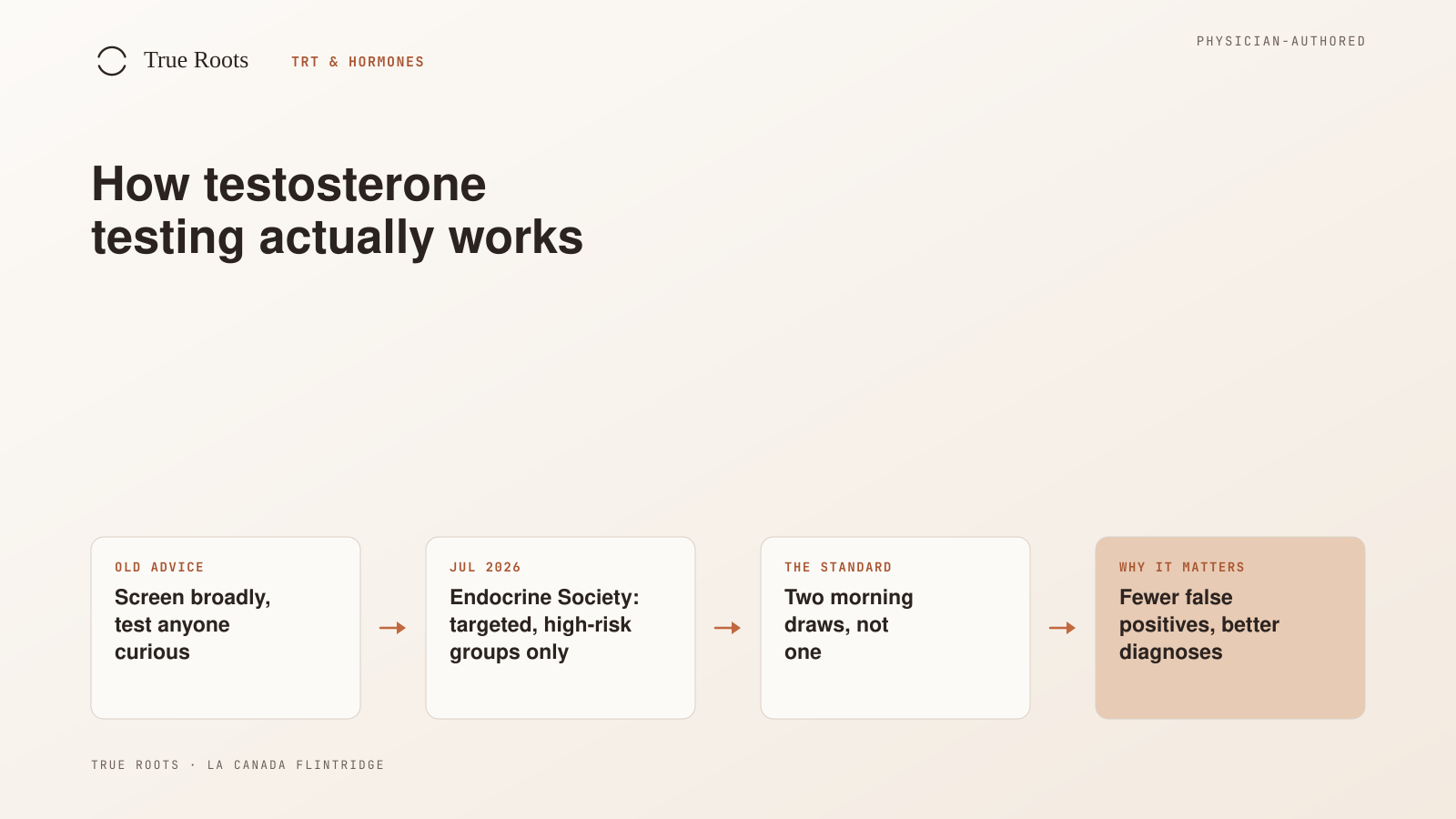
Not every man needs a testosterone test, and a July 2026 Endocrine Society statement is explicit about this: it advises against routine, population-wide low-T screening, since the symptom-based questionnaires used for casual case-finding lack the sensitivity and specificity to be useful at scale. What it does recommend is targeted screening in specific high-risk groups, including men with type 2 diabetes and metabolic syndrome. The same statement reinforces the two-morning-draw diagnostic standard covered below. The practical takeaway: if you are in a higher-risk group or have a real cluster of symptoms, testing is worth pursuing; blanket screening for every man regardless of symptoms or risk factors is not the current standard of care.
Why one test is not enough
A single low result does not equal a diagnosis. Testosterone fluctuates day to day, and lab values can vary, so the standard is to confirm a low level on a second morning draw on a separate day. This protects you in both directions: it avoids labeling someone as low based on an off day, and it avoids dismissing a real case as a fluke. Confirmation is a feature of careful care, not an inconvenience.
What happens after testing?
Once your results are in, a physician interprets them alongside your symptoms and overall health. If your levels are normal, you have ruled out a common cause and can investigate other explanations for how you feel. If your levels are genuinely low and you have symptoms, your physician will discuss options, including whether TRT is appropriate and how it would be monitored. The same panel is also used to track safety once treatment begins. To recognize the symptoms that should prompt testing, see low testosterone symptoms.
This article is educational and not a substitute for personalized medical advice.