
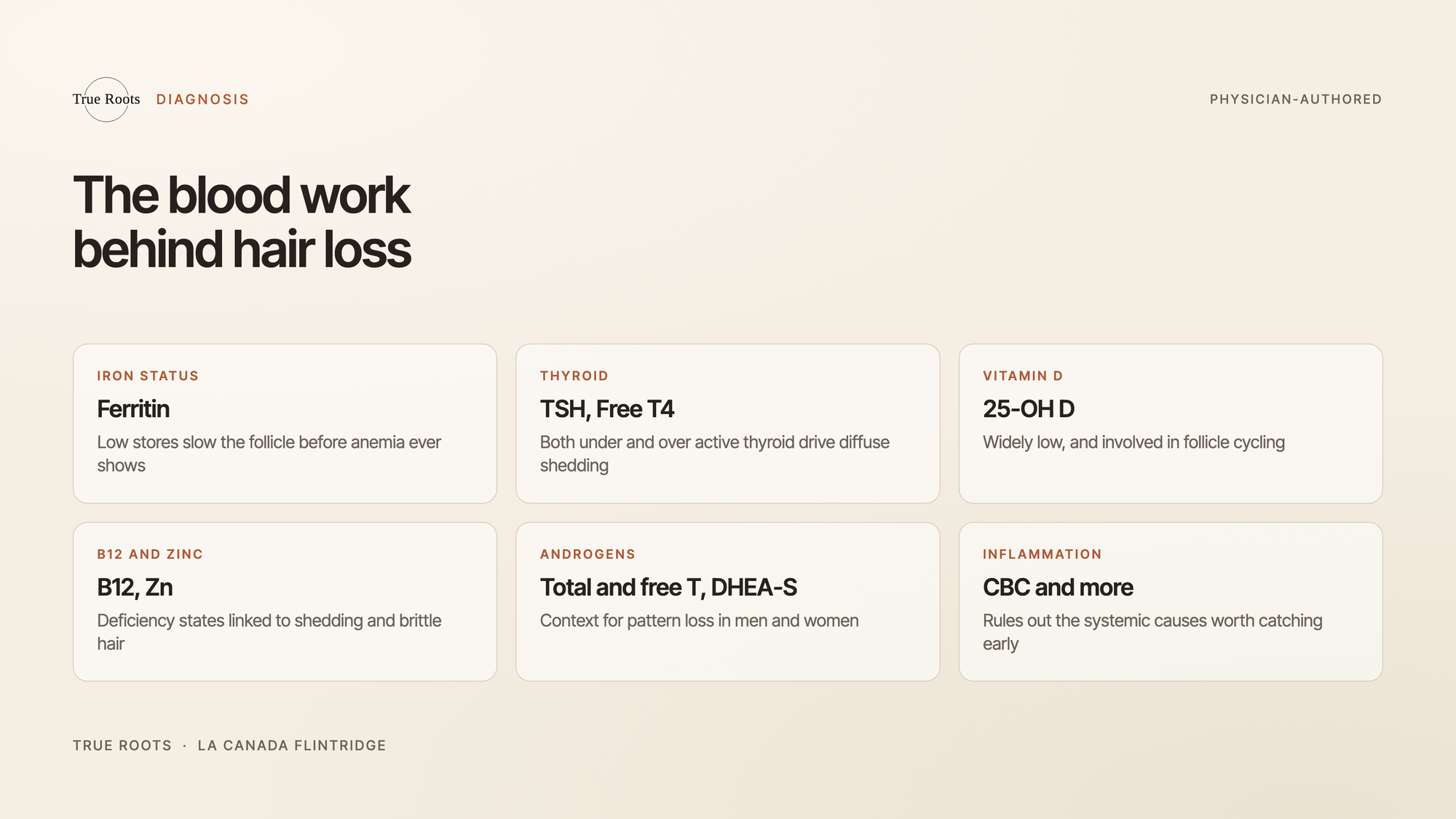
Treating hair loss without blood work is guessing. A useful panel covers ferritin, a complete blood count, TSH with free T4, vitamin D, B12, zinc, and the relevant sex hormones. The reason is simple: a laser, a pill, or a topical will underperform if something metabolic is quietly holding the follicle back, and some causes resolve once corrected.
Why does hair loss need blood work at all?
Because the follicle is one of the most metabolically demanding structures in the body. It is a small organ that runs a continuous cycle of rapid cell division, and it is unusually quick to shut that cycle down when the body decides resources are better spent elsewhere.
That is why so many systemic problems announce themselves at the scalp first. Low iron stores, a drifting thyroid, a nutritional gap, a hormonal shift: none of them are hair diseases, and all of them can thin hair.
Pattern hair loss and a metabolic contributor also coexist constantly. Finding one does not rule out the other. It usually means both need addressing, which is the point of testing before you commit to a treatment plan.
What does ferritin tell you about hair, and why not just iron?
Ferritin measures stored iron. Serum iron measures what is circulating right now, which fluctuates with your last meal and tells you very little about reserves.
Hair follicles draw on stored iron to sustain anagen, the active growth phase. Stores can be low well before a standard complete blood count shows anemia, which is why a patient can be told "your iron is fine, you are not anemic" and still be shedding.
The practical framing used by many hair specialists is that ferritin should sit comfortably above the low end of the range rather than merely inside it. Exact targets are debated in the literature and should be set by your physician against your own labs and history, not by a number found online.
One more thing worth doing: if ferritin is low, the next question is why. Low iron stores in an adult man, or in a woman without heavy periods, deserves a look at the cause and not just a supplement.
What can a CBC and thyroid panel reveal?
A complete blood count catches anemia, which alone can drive diffuse shedding, and it flags broader issues worth chasing before anyone talks about lasers.
Thyroid is the other high-yield test. Both hypothyroidism and hyperthyroidism can push a large share of follicles out of anagen and into the resting phase, producing a diffuse thinning across the entire scalp rather than a receding hairline. TSH is the screening test, but TSH in isolation can miss a picture that free T4 clarifies, so the two are usually run together. Reverse T3 is sometimes added when the clinical picture and the standard results disagree, though its interpretation is less settled.
Thyroid-driven shedding frequently improves once the thyroid is treated properly. That is a very different plan from a device protocol, which is exactly why the test comes first. For the wider differential, see what is causing my hair loss.
Which nutrients actually matter?
Vitamin D, B12, and zinc are the three worth measuring, because deficiency in each is common enough to be worth ruling out and correctable when found.
Vitamin D receptors are present in the hair follicle and low levels are associated with several hair loss patterns, though correcting a deficiency should be framed as removing an obstacle rather than as a treatment for pattern hair loss. B12 deficiency affects red blood cell production and oxygen delivery, and it is more common in people who are vegetarian, on long-term metformin, or on long-term acid suppression. Zinc is required for follicle protein synthesis, and true zinc deficiency can cause shedding.
Note the word "deficiency" in all three cases. That is the operative principle for the whole nutrient category.
What about testosterone, DHT, and hormones?
For men, total and free testosterone are the useful starting point, with SHBG providing context for the free number. It is worth being precise about what this does and does not explain, because the relationship is widely misunderstood.
Low testosterone is not a typical cause of pattern hair loss. Male pattern baldness is driven by inherited follicle sensitivity to DHT rather than by how much testosterone is circulating, which is why a man with excellent levels can still lose hair. Routine DHT measurement rarely changes the plan. The testosterone panel earns its place because it identifies a treatable deficiency and because it informs the conversation about what happens to a hairline on therapy, covered in does TRT cause hair loss.
For women, the picture is different. When thinning is accompanied by irregular cycles, acne, or unwanted facial hair, testosterone, DHEA-S, and prolactin are worth checking to identify an androgen excess or a pituitary cause. Around the menopause transition, declining estrogen is usually the driver, which is covered in menopause hair loss.
What does each result actually change?
| Marker | What it tells you about hair | What to do if it is off |
|---|---|---|
| Ferritin | Iron stores available to sustain the growth phase | Correct the deficiency and investigate why stores are low, then reassess shedding |
| CBC | Anemia and broader systemic issues | Identify the cause of the anemia and treat it before judging a hair plan |
| TSH with free T4 | Whether thyroid function is pushing follicles out of anagen | Treat the thyroid properly. Diffuse shedding often improves as levels normalize |
| Vitamin D | A common, correctable deficiency associated with hair loss | Repletion under physician guidance, framed as removing an obstacle |
| B12 | Oxygen delivery and cell turnover, relevant in vegetarian, metformin, or acid-suppression contexts | Repletion and a look at absorption |
| Zinc | Protein synthesis in the follicle | Correct a true deficiency. Do not supplement zinc blindly |
| Total and free testosterone (men) | Identifies deficiency and frames the DHT conversation | Treat a genuine deficiency and screen the scalp before starting therapy |
| Androgens, DHEA-S, prolactin (women) | Androgen excess or a pituitary cause when the pattern suggests it | Investigate the source and address it before or alongside hair treatment |
So should you just take biotin?
Only if you are deficient in biotin, which is uncommon for anyone eating a normal diet. This deserves a straight answer because it is the most common thing patients arrive already doing.
Supplementing a nutrient you are not low in does not grow hair. Biotin earned its reputation from cases of genuine deficiency, and the results in that setting do not transfer to everyone else. There is also a practical hazard: high-dose biotin can interfere with certain lab assays, including thyroid and cardiac markers, so tell your physician if you are taking it before blood is drawn.
The better version of the same instinct is to test, correct what is genuinely low, and put the effort into a treatment that acts on the follicle. See the best hair loss treatments.
Why physician-led matters here
This is the part of hair restoration that a device alone cannot do. Interpreting a panel against your history, your exam, and your goals is clinical work, and it is what determines whether a treatment plan is aimed at the right target.
At True Roots Performance & Aesthetics in La Canada Flintridge, board-certified physician Dr. Luis Valle reviews blood work as part of the hair restoration evaluation before recommending any protocol, for patients from La Canada Flintridge, Pasadena, Glendale, and across greater Los Angeles. More on that approach in why physician-led care matters.
This article is educational and not a substitute for personalized medical advice.