
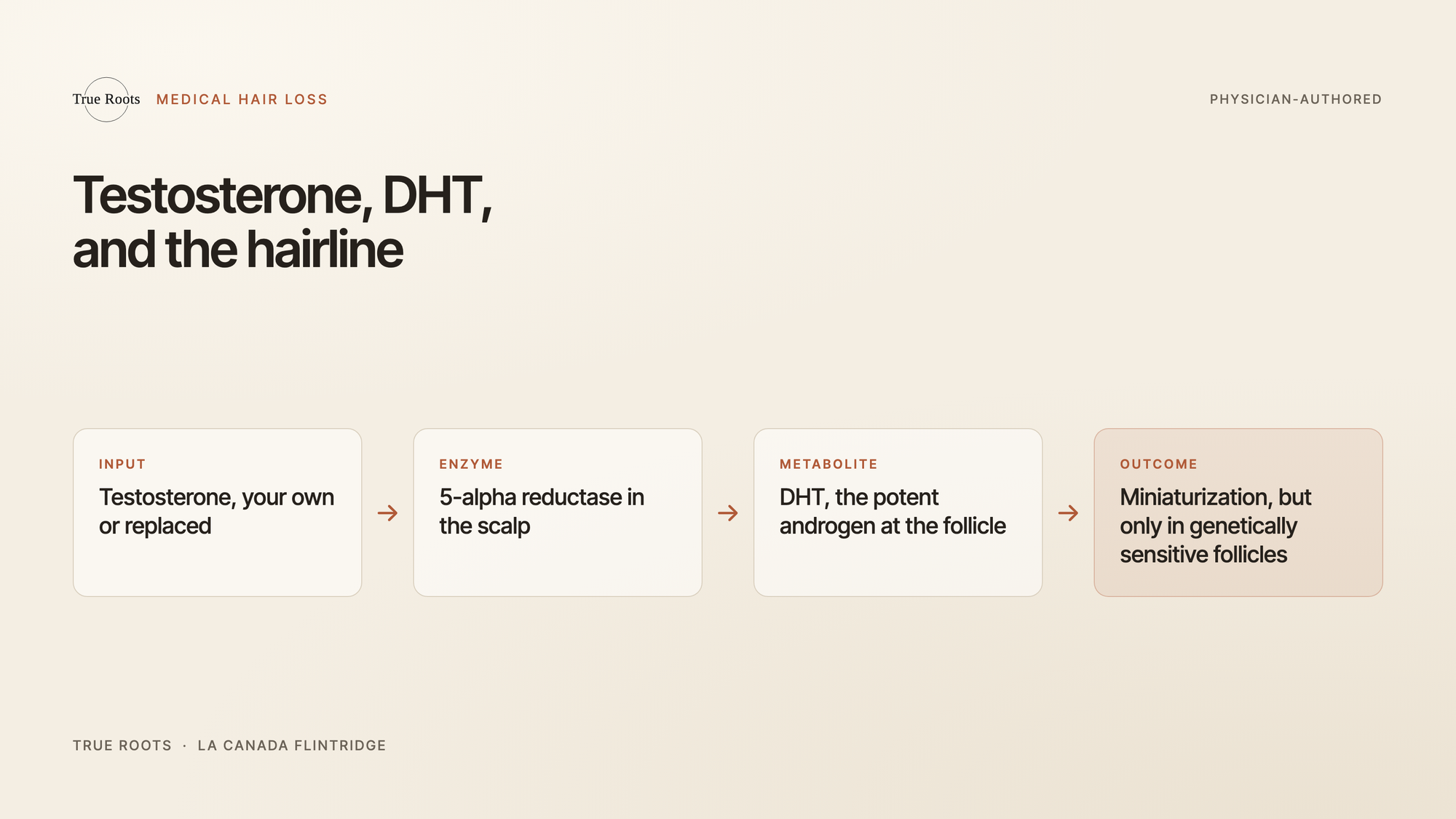
TRT does not create male pattern baldness in a man who is not genetically predisposed. What it can do is move up the timeline for a man who was already going to lose hair. More testosterone means more substrate for 5-alpha reductase to convert into DHT, and it is inherited follicle sensitivity to DHT that drives miniaturization.
That nuance is the entire answer. Here is the mechanism, who is actually at risk, and what your options are if you want to stay on therapy.
What is the actual mechanism?
Testosterone is not the molecule that miniaturizes follicles. Its metabolite is.
The enzyme 5-alpha reductase converts testosterone into dihydrotestosterone, or DHT, which binds androgen receptors in the hair follicle far more avidly than testosterone does. In follicles that carry inherited sensitivity to DHT, that binding progressively shortens the anagen growth phase. Each cycle produces a slightly finer, shorter, less pigmented hair until the follicle produces nothing visible at all. That process is miniaturization, and it is the whole of androgenetic alopecia.
Two facts follow from this, and they are the ones most men have backwards.
First, sensitivity is genetic and follicle-specific. It is why baldness follows a pattern: the follicles at the temples and crown carry the sensitivity while those at the back and sides largely do not. That regional difference is why hair transplants work at all.
Second, more testosterone does not create sensitivity where none exists. It supplies more raw material to an enzyme, which in a sensitive follicle means more of the signal that was already causing the damage. In an insensitive follicle, the same DHT arrives and nothing meaningful happens.
Who is actually at risk on TRT?
Not everyone. The men who see a change on therapy are overwhelmingly the men who had the process already running.
Three markers matter, and they are all assessable before you start:
Family history. Pattern baldness on either side of the family raises your prior probability considerably, and the earlier it appeared in relatives, the more it matters.
Existing recession. Any temporal recession, any thinning at the crown, or a part line that has widened over the last few years is direct evidence the process is underway. See male pattern baldness stages.
Early miniaturization on exam. This is the one you cannot self-assess. Under magnification, a scalp that still looks normal can show variability in hair shaft diameter, which is miniaturization in progress well before density visibly drops.
A man with none of the three is unlikely to attribute much to therapy. A man with all three should assume TRT will compress his timeline and plan accordingly.
What can you do about it while staying on TRT?
You have real options, and they trade off along one axis: whether you are willing to touch the hormonal system you started TRT to optimize.
Finasteride inhibits 5-alpha reductase and lowers DHT, which addresses the mechanism directly and has the strongest evidence base of the medical options. The honest tradeoff is that DHT is not a waste product. It contributes to libido and erectile function in some men, and a minority report sexual side effects on treatment. There is also a philosophical objection worth naming: you started TRT to raise an androgen and finasteride blocks the conversion of that androgen. Both concerns are legitimate. Neither is automatically disqualifying, and the decision belongs in a conversation with a physician who is monitoring your labs and your scalp. Detail in FoLix vs. finasteride and minoxidil.
Topical minoxidil works through a different mechanism entirely, prolonging the growth phase and improving follicular blood flow without touching androgens. It requires daily application indefinitely, and stopping reverses the gains.
FoLix is the drug-free path. It is a 1565 nm non-ablative fractional laser, FDA-cleared for androgenetic alopecia, that stimulates follicles through a controlled healing response in the scalp. It does not alter testosterone, DHT, or 5-alpha reductase, which means it runs alongside TRT without complicating the hormonal plan. Sessions take about 30 minutes with no downtime, and the protocol is a series of 3 to 6 treatments about 4 weeks apart with maintenance roughly every 6 months. Results vary. See the engineering behind the device.
| Approach | What it does | Hormonal | Main tradeoff |
|---|---|---|---|
| Finasteride | Inhibits 5-alpha reductase, lowering DHT | Yes | Blocks the same DHT some men value. A minority report sexual side effects |
| Topical minoxidil | Prolongs the growth phase, improves follicular blood flow | No | Daily application indefinitely. Gains reverse if you stop |
| FoLix laser | Stimulates follicles via a controlled healing response in the scalp | No | A series of in-office sessions plus maintenance. Works best while follicles are still living |
| Do nothing | Accepts the natural course, possibly accelerated | No | Miniaturization is easier to slow than to reverse once follicles are gone |
| Stop TRT | Removes the extra substrate for DHT conversion | Yes | Symptoms of low testosterone return, and the underlying genetic pattern continues regardless |
That last row deserves emphasis. Stopping TRT does not restore a hairline, because it does not remove the genetic sensitivity that was driving loss before you started. It typically returns you to your original trajectory, along with the symptoms that sent you to a physician in the first place.
Why you should screen your scalp before you start
Because the difference between an informed choice and an unpleasant surprise is one exam.
A scalp assessment before your first injection does three useful things. It establishes whether miniaturization is already underway, which is the single best predictor of what therapy will do to your hairline. It creates a photographic baseline, so six months later you are comparing images rather than arguing with your memory. And it lets you start a hair strategy at the same time as TRT, which is far more effective than starting one after visible density is gone.
Hair loss is easier to slow than to reverse. Once a follicle has fully miniaturized, no device or drug brings it back. That is the real argument for screening first, and it applies whether you decide to treat or not.
At True Roots Performance & Aesthetics in La Canada Flintridge, board-certified physician Dr. Luis Valle runs both sides of this conversation under one roof: physician-led TRT and FoLix hair restoration, evaluated together rather than as separate problems. Patients come from La Canada Flintridge, Pasadena, Glendale, and across greater Los Angeles. See TRT in Pasadena.
This article is educational and not a substitute for personalized medical advice.