
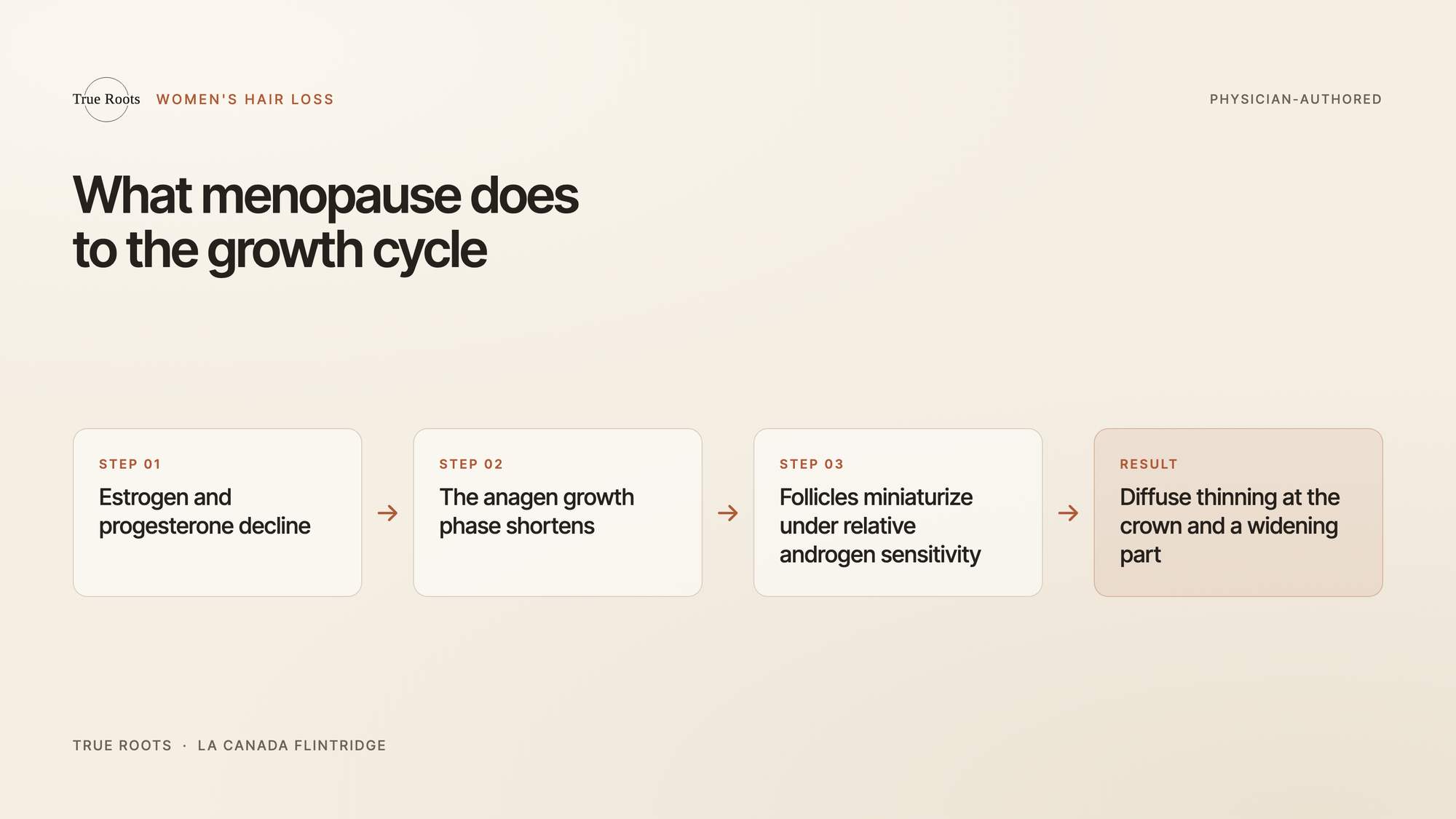
Menopausal hair thinning is driven by falling estrogen and progesterone, which shorten the hair's growth phase while the follicle's relative sensitivity to androgens rises. About half of women report increased shedding or visible thinning through the transition. It shows up as diffuse thinning at the crown and a widening part, and unlike postpartum shedding, it does not resolve on its own.
Why does menopause thin your hair?
Every hair follicle cycles: a long growth phase (anagen), a short transition, and a resting phase before the hair releases. Estrogen supports a long anagen phase. That is the whole mechanism in one sentence.
As estrogen and progesterone decline through perimenopause and beyond, anagen gets shorter. Hairs spend less time growing, so each replacement hair is a little shorter and a little finer than the one before it.
At the same time, androgens do not have to rise for their influence to grow. With less estrogen opposing them, the follicles that are genetically sensitive to androgens begin to miniaturize. Roughly half of postmenopausal women are affected to some degree.
What does menopausal hair loss actually look like?
Not a receding hairline. Female pattern thinning concentrates across the top of the scalp: the center part widens, more scalp shows under overhead light, and the frontal hairline usually stays where it is.
The first thing most women notice is not a bald area at all. It is the ponytail: fewer wraps of the elastic, a thinner rope of hair, less body when it is down.
Progression is slow enough that it is easy to dismiss for years, which is the single biggest reason women arrive later than they should.
How is this different from postpartum or stress-related shedding?
This distinction determines your whole strategy, so it is worth being precise about.
| Menopausal thinning | Telogen effluvium (postpartum, stress, illness) | |
|---|---|---|
| Onset | Gradual, over years | Sudden, 2 to 3 months after a trigger |
| Pattern | Crown and part, hairline preserved | Diffuse across the entire scalp |
| Main symptom | Loss of density and volume | Heavy daily shedding |
| Course | Persistent and progressive | Self-limiting |
| Right response | Treat now, while follicles live | Find the trigger, correct it, wait |
| Regrows without treatment | Usually not | Usually yes |
Both can be present at once, which is common in the perimenopausal years when sleep, stress, and thyroid changes stack up. See postpartum hair loss for the temporary side of that picture.
Why waiting it out is the wrong strategy
With postpartum shedding, patience is the correct medicine. Here it is not.
The hormonal driver of menopausal thinning does not reverse. Each cycle produces a slightly finer hair, and miniaturized follicles eventually stop producing a visible hair at all. Once a follicle is gone, no treatment brings it back.
Everything that works in female pattern thinning works on follicles that are still alive. That is why the same treatment started at year two performs differently than at year ten. Results vary in either case, but the ceiling is higher early.
What actually works for menopausal hair thinning?
There are three honest categories, and most good plans use more than one.
Treat the hormonal and metabolic drivers. Before anything else, rule out what is fixable: ferritin, thyroid function, vitamin D, and B12 all influence hair density, and low iron stores are common in the years leading up to the final period. See hair loss blood tests. Hormone therapy is a separate conversation. It can help some women, but hair regrowth is not an approved indication for it, and the risk and benefit discussion has changed in recent guidance. We cover that in the FDA hormone therapy label change.
Minoxidil, topical or low-dose oral. Still the best studied medical option for female pattern thinning. It extends the growth phase, and it requires ongoing use to hold the gains. Oral low-dose minoxidil is prescription and physician-monitored.
FoLix, the drug-free device option. FoLix is a 1565 nm non-ablative fractional Er:Glass laser, FDA-cleared to improve the appearance of scalp hair in adults with androgenetic alopecia, Fitzpatrick skin types I to IV. Sessions run about thirty minutes with no needles, no anesthesia, and no downtime. The protocol is three to six sessions roughly four weeks apart, then maintenance about every six months. Results generally start around eight to twelve weeks with continued gains through three to six months, and results vary.
FoLix suits the woman who wants a serious intervention without adding a daily medication, and it works best in early to middle stages. FoLix for women goes deeper on candidacy and expectations.
Where to start
Start with a diagnosis, not a product. The same visible thinning can be pattern loss, a thyroid problem, iron depletion, or two of those at once, and treating the wrong one wastes a year you do not want to spend.
A proper evaluation means a scalp exam, a history that includes your menopausal timeline, and labs. From there the plan is built around what is actually driving it.
Physician-led hair restoration in La Canada Flintridge
True Roots Performance & Aesthetics is in La Canada Flintridge and sees patients from Pasadena, Glendale, and across greater Los Angeles. Hair restoration is physician-led by Dr. Luis Valle, a board-certified physician, so the menopausal piece and the hair piece are evaluated by the same person rather than split between a dermatologist and a med spa.
This article is educational and not a substitute for personalized medical advice.