
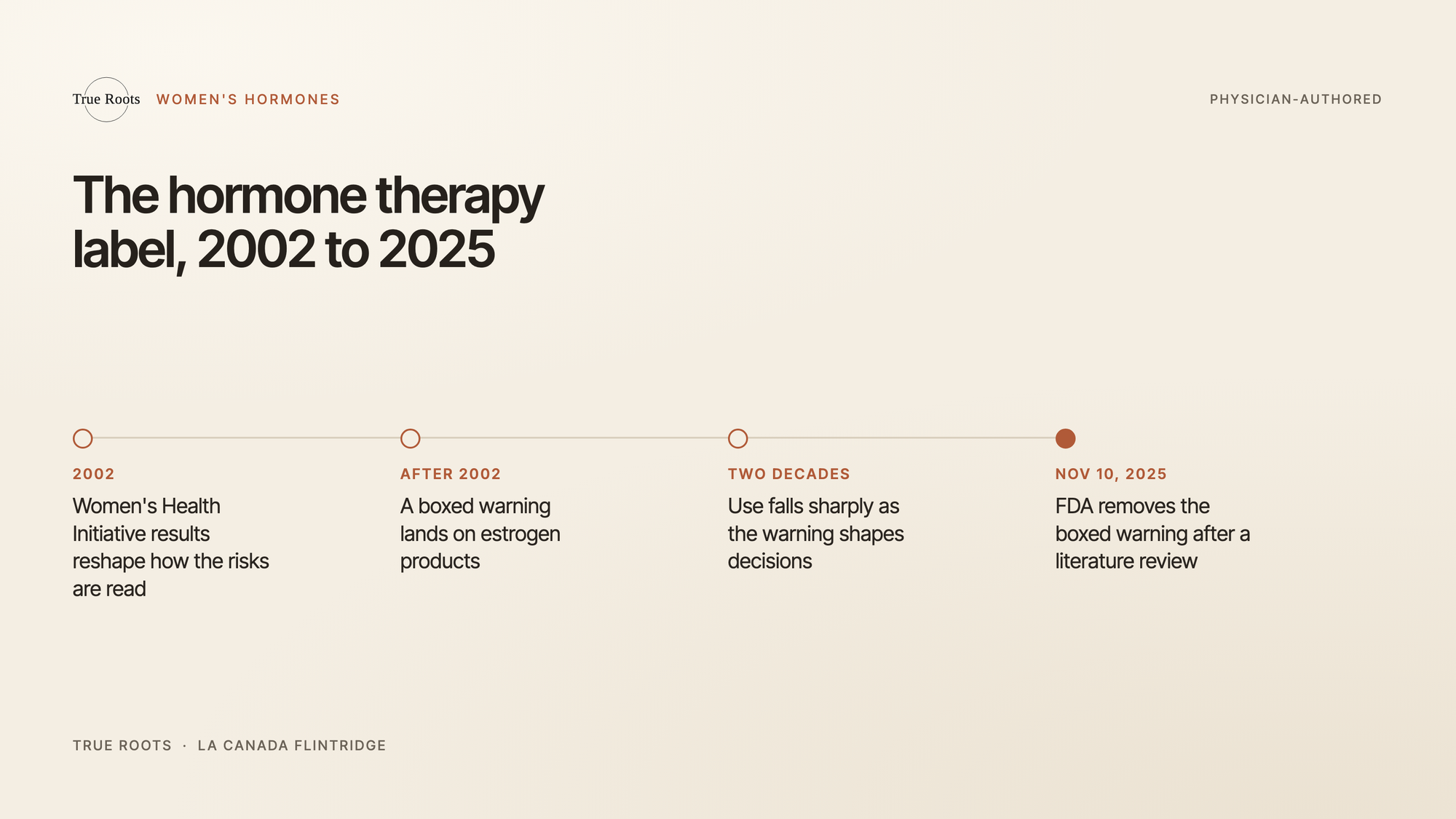
On November 10, 2025, the FDA announced it was removing the boxed warning from estrogen-containing menopausal hormone therapy products, covering six products, after a review of the scientific literature. The removed statements concerned cardiovascular disease, breast cancer, and probable dementia. The endometrial cancer warning on systemic estrogen-only products stayed. This is a labeling change, not a blanket endorsement.
That distinction matters, so let us walk through what actually changed, what did not, and what it means if you are weighing hormone therapy.
What did the FDA actually change?
The agency removed the boxed warning, the most serious form of warning the FDA applies to a prescription label, from estrogen-containing menopausal hormone therapy products. The announcement came on November 10, 2025 and followed a review of the scientific literature.
Three risk statements came off: cardiovascular disease, breast cancer, and probable dementia. The FDA's stated rationale was that these risks had been overstated for the population most likely to benefit from treatment.
Labels are being rewritten with age-specific guidance, reflecting evidence that women may see long-term benefit when therapy is started within about 10 years of the onset of menopause.
Why was the warning there in the first place?
Because of the fallout from the Women's Health Initiative in 2002.
The WHI was a large trial, and its early results were communicated to the public in a way that produced something close to a panic. Hormone therapy use fell sharply and stayed down for two decades. A generation of women went through menopause without a treatment their mothers had used, and a generation of physicians trained in an environment where prescribing it felt legally and clinically risky.
The core problem, as the evidence accumulated in the years since, was one of population. The women studied were on average considerably older than the women who actually present with menopausal symptoms, and risk in an older cohort starting therapy years past menopause does not transfer cleanly to a woman in her early fifties starting at the onset of symptoms.
What is the timing hypothesis?
The timing hypothesis is the idea that when you start hormone therapy changes the risk and benefit calculation substantially.
The reasoning is vascular. Estrogen appears to have a favorable effect on blood vessels that are still relatively healthy, and a less favorable one on vessels where atherosclerotic disease has already established itself. Start close to the menopause transition and you are working with the former. Start fifteen years out and you may be working with the latter.
This is the evidence the FDA cited when it described age-specific guidance and the roughly 10-year window from the onset of menopause. It is also why "is hormone therapy safe" is an unanswerable question in the abstract. Safe for whom, started when, at what dose, by what route, with what history.
What did not change?
This is the part that gets lost in headlines, so here it is plainly.
| What changed | What did not |
|---|---|
| Boxed warning removed for cardiovascular disease, breast cancer, and probable dementia | Boxed warning for endometrial cancer on systemic estrogen-only products remains |
| Labels being rewritten with age-specific guidance | Individual contraindications and risk factors are unchanged |
| The framing of risk for women near the onset of menopause | The requirement for a personal evaluation before prescribing |
| Six estrogen-containing products affected | Hormone therapy is still a prescription decision, not an over-the-counter one |
The endometrial cancer warning stayed for a specific physiological reason: unopposed systemic estrogen stimulates the uterine lining. That is why women with a uterus are generally prescribed progesterone alongside estrogen, and that practice is unaffected by this decision.
Individual contraindications also remain exactly where they were. A personal history of certain breast cancers, a history of blood clots, established cardiovascular disease, and several other factors still change the calculation. The label reflects population-level evidence. Your physician has to apply it to one person.
And a labeling decision is not a recommendation to start treatment. It removes a warning that the FDA concluded was overstated for the population most likely to benefit. It does not tell any individual woman what to do, which is covered in more practical detail in hormone therapy for women.
What does this mean for hair and skin?
Estrogen supports the hair follicle's growth phase. As estrogen declines through perimenopause and menopause, that growth phase shortens, more follicles sit in the resting phase at any given time, and the result is the diffuse thinning across the crown and part line that so many women notice in their late forties and fifties.
That is the honest connection, and it is worth stating the limit clearly. Hair is not an approved indication for hormone therapy and it is not prescribed for that reason. Some women notice hair changes when their hormones are addressed. Results vary, and hormone therapy is not a hair loss treatment.
If thinning is what brought you here, the fuller picture is in menopause hair loss, and the diagnostic starting point is in the blood work behind hair loss. Pattern thinning is often addressed separately from hormones, including with FoLix for women.
What should you actually do with this news?
Treat it as permission to have the conversation, not as an answer.
If you dismissed hormone therapy years ago because of what you heard about the WHI, or because a physician was reluctant to discuss it, the evidentiary basis for that reluctance has shifted and it is reasonable to revisit it. If you are early in the transition and symptomatic, the timing evidence is specifically relevant to you.
If you have a personal history that raised concerns before, those concerns did not disappear on November 10, 2025. They are still yours to work through with someone who has your full history in front of them.
At True Roots Performance & Aesthetics in La Canada Flintridge, women's hormone evaluation is physician-led by board-certified Dr. Luis Valle, who reviews your symptoms, labs, and history before recommending anything, for patients from La Canada Flintridge, Pasadena, Glendale, and across greater Los Angeles. More on that standard in why physician-led care matters.
This article is educational and not a substitute for personalized medical advice.