
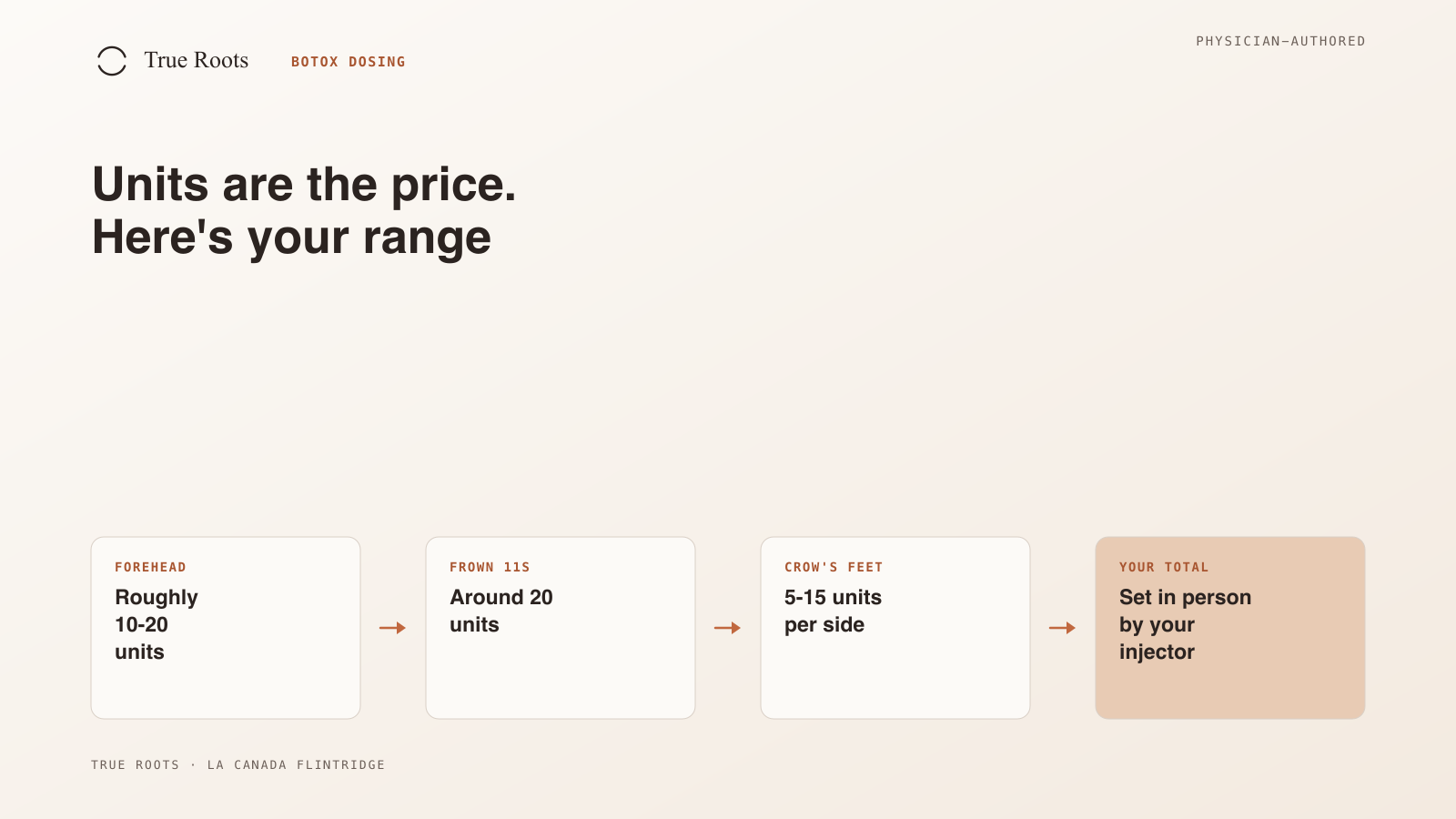
Most people need roughly 20 to 40 units of Botox for a typical upper-face treatment. For reference, the FDA-approved Botox Cosmetic label lists 20 units for frown lines, 20 units for forehead lines (40 units when the two are treated together), and 24 units total for crow's feet, and injectors often tailor below those totals for a softer result. At True Roots in La Cañada Flintridge, near Pasadena and Glendale, Botox is $12 per unit, so units times $12 is your price. Your final dose is set in person by our Botox-specialist nurse practitioner based on your muscle strength and goals.
How many units of Botox do most people need?
Most first treatments fall between 20 and 40 units total. Treat one area lightly and you might use 10 to 20; treat all three standard upper-face zones and you can reach 40 or more. The range is wide because muscle strength, facial anatomy, and your goal (soften versus fully relax) all move the number.
In common practice a first treatment usually lands in that 20-to-40-unit band, below the combined label totals, because few people treat every area at full label dose at once. Where you land inside it is an in-person decision.
How many units for the forehead?
The FDA Botox Cosmetic label dose for forehead lines is 20 units, placed as 4 units at each of 5 sites. In common practice, injectors often use about 10 to 20 units here, and this is the one area where restraint matters most.
The frontalis muscle that creates horizontal forehead lines is also the muscle that lifts your eyebrows. Over-treat it and you trade lines for a heavy, flat, slightly tired upper face. Good injectors start on the lower end here and adjust at a follow-up rather than flooding the area on day one.
How many units for frown lines (the 11s)?
The FDA label dose for the frown lines between the brows, the "11s" or glabellar lines, is 20 units, given as 4 units at each of 5 sites. That is the most standardized number of the three, because the glabellar complex is a consistent, strong group of muscles that pull the brows together.
This is also the area most people first notice in photos, where a crease that used to vanish starts lingering after the expression relaxes. Lines that still disappear at rest generally respond to lighter dosing than ones that have already etched in.
How many units for crow's feet?
The FDA label dose for crow's feet (lateral canthal lines) is 24 units total, 12 per side. In common practice, lighter treatments often use less, roughly 5 to 15 units per side. The key word is per side: both eyes add up, so a crow's feet treatment is really two doses.
The orbicularis oculi muscle that fans out from the eye corner varies a lot in strength from person to person, which is why practice doses range. Expressive, deep-set smilers often need the higher end.
A quick dosing reference
| Area | FDA label dose | Common practice range |
|---|---|---|
| Forehead lines | 20 units | About 10 to 20 units |
| Frown lines (the 11s) | 20 units | About 15 to 20 units |
| Crow's feet | 24 units total | About 5 to 15 units per side |
| Typical first upper-face treatment | Up to ~40+ units combined | About 20 to 40 units total |
Treat this as a map, not a prescription. The same face can be dosed differently depending on whether the goal is a soft, natural result or a fuller freeze.
What about baby Botox doses?
Baby Botox uses a fraction of standard dosing, often roughly a third to a half, placed precisely to soften movement while keeping full expression. In unit terms that might mean a handful of units per area rather than the fuller ranges above.
The tradeoff is duration: smaller doses tend to wear off a little sooner, so you trade a softer, more natural look for slightly more frequent visits. If prevention is your goal, see baby Botox and starting early for who it actually fits.
How do units translate to price?
Directly. At True Roots, Botox is $12 per unit as of October 2026, so your cost is units times $12, with no per-area markup layered on top.
That makes the math simple once a plan is set:
- 20 units: $240
- 30 units: $360
- 40 units: $480
This is why knowing your unit count matters more than hunting for the lowest "per area" offer. A flat per-area price hides how many units are included, while units times a transparent per-unit rate is something you can compare clinic to clinic. For the full LA market picture, see how much Botox costs in Los Angeles.
Who should start low, and who needs more?
Start low if you are a first-timer, you want a soft natural result, or you are treating the forehead, where restraint protects your brows. A lighter dose lets you see how you respond and add a touch at a two-week follow-up.
You likely need more if your muscles are strong (common in men), your lines are well established, or you are treating an expressive area like the frown or crow's feet at full strength. More units is not a better result; precise placement is, and the right dose is the one matched to your anatomy and goal.
If your lines vanish the instant your face relaxes, you may not need treatment yet at all. An honest assessment will say so rather than sell you a dose you do not need.
Why your number is set in person
Dosing ranges are educational, not a promise, because the right dose depends on things a chart cannot see: how strong your muscles actually are, how your left and right sides differ, and whether you want movement softened or stopped.
Men often need more units than the common female ranges, since facial muscles tend to be larger and stronger. First-timers frequently do better starting lighter and adding a little at a two-week follow-up, because it is easier to add units than to wait out a dose that was too heavy. At True Roots, your Botox-specialist nurse practitioner reads your specific movement and builds the plan with you, which is the part that determines whether you look rested or overdone.
How many units of Botox in La Cañada Flintridge
True Roots Performance & Aesthetics is in La Cañada Flintridge, California, serving Pasadena, Glendale, and greater Los Angeles. Botox is $12 per unit, performed by our Botox-specialist nurse practitioner, who sets your dosing plan in person. If jaw tension or a squared lower face is on your mind, that is a different dosing question covered in masseter Botox.
This article is educational and not a substitute for personalized medical advice.