
Baby Botox uses a fraction of a standard neuromodulator dose, often roughly a third to a half, placed precisely to soften movement while keeping natural expression. As prevention it works in a specific, limited sense: it slows the process by which repeated folding etches lines permanently into skin. It does not stop aging. Results vary.
That is the honest answer to a question people in their late twenties and early thirties are asking constantly, usually after seeing a line in a photo that used to disappear.
What does baby Botox actually mean?
It is not a different product or a lighter formula. It is a dosing and placement philosophy: less product, distributed with more precision, aimed at reducing the strength of a movement rather than eliminating it.
The practical difference is that the muscle still moves. You still furrow, still smile, still look like yourself in a video call. What changes is how hard the muscle pulls, and therefore how sharply the skin above it creases.
Does starting early actually prevent wrinkles?
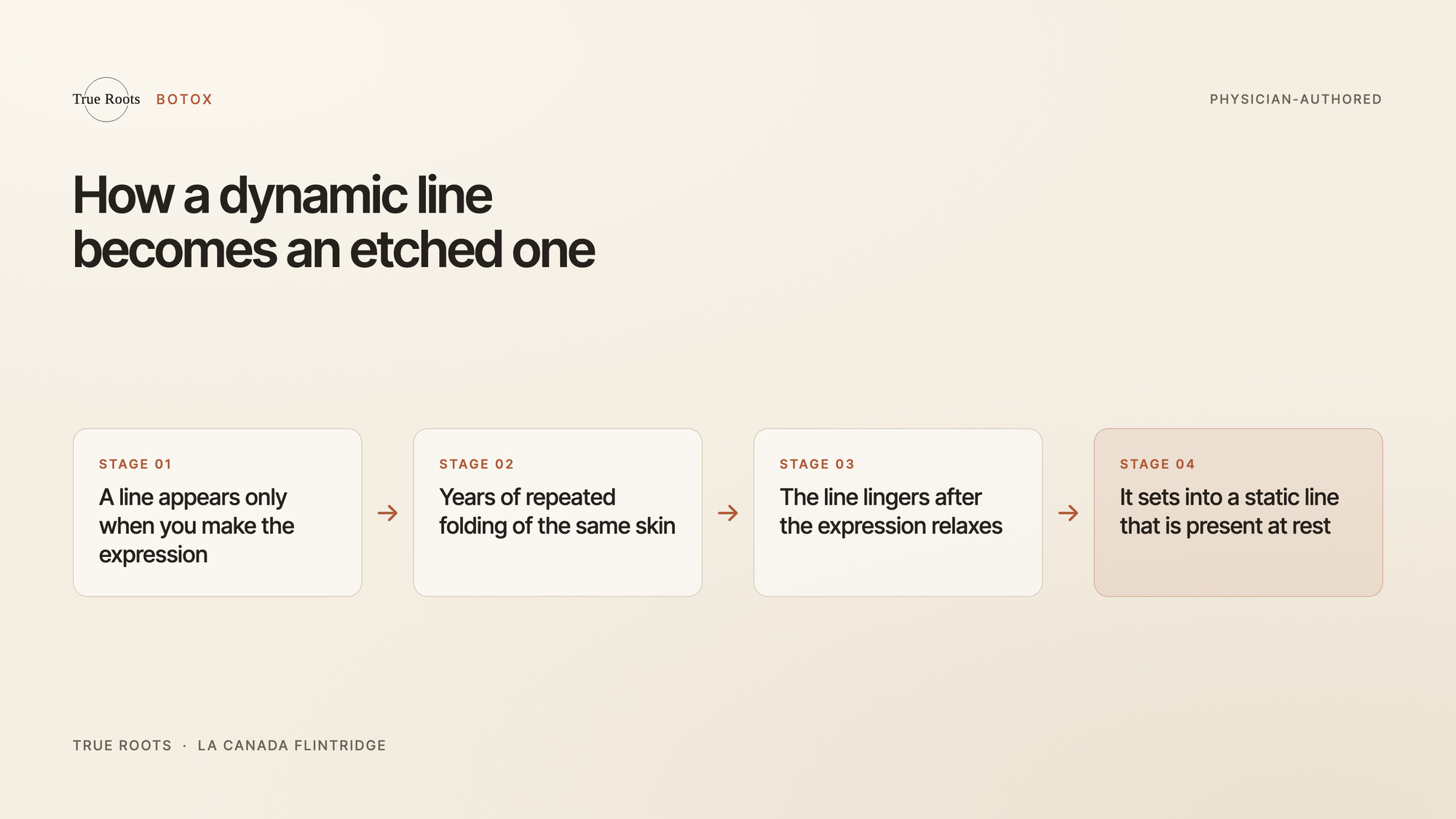
The prevention logic is real, and it is simple enough to check yourself. Make a frown and look at the line between your brows. That is a dynamic line, present only during movement.
Fold that same skin thousands of times over a decade and the crease starts persisting after the expression relaxes. Eventually it stays put entirely. That is a static, etched line, and once it is etched, it is much harder to reverse than it was to prevent.
Reducing the depth and frequency of that folding slows the etching. That is the defensible claim, and it is worth something. What it is not is a guarantee against aging. Sun exposure, collagen loss, volume change, and genetics all continue on their own timeline, and no neuromodulator touches any of them.
Why is this question coming up so much more now?
Because the search for it is climbing fast, and not by accident. Interest in "preventative Botox" among 18 to 24 year olds is up roughly 75 percent recently, and neurotoxin treatments now make up about a fifth of Gen Z's total non-surgical aesthetic spend, up from roughly a tenth just a few years ago. That is a real generational shift in when people start asking this question, not just a trend piece. It does not change the answer below. The right time to start is still about your skin, not your age bracket or your feed.
Who is actually a good candidate?
The signal is not a birthday. It is whether your dynamic lines linger for a beat after your face relaxes.
Look in a mirror. Raise your brows, then relax completely. If a faint line stays visible for a second or two after the movement stops, the etching process has started. That is the moment where prevention has something real to do. Some people hit it at 27, some at 38.
If your skin snaps back flat the instant you relax, there is nothing to prevent yet. Starting anyway is not harmful, but it is not automatically better either, and it starts a maintenance clock earlier than it needed to start.
Which areas are typically treated?
The three standard zones are the ones driven by repeated expression: the frown lines between the brows, the horizontal forehead lines, and the crow's feet at the outer corners of the eyes.
Forehead placement is where restraint matters most, since the same muscle that creates those lines also lifts your brows. Over-treating it is the classic cause of a heavy, flat-looking upper face. Smaller doses placed thoughtfully are how that gets avoided.
Why does less product placed well beat more product placed generically?
Precision does the work that volume cannot. Every face has a different muscle pattern: different strength, different fiber direction, different asymmetries between the left and right side.
A generic injection pattern applies the same map to every face and compensates with dose. A tailored pattern reads your specific movement, treats the muscles that are actually pulling, and leaves the ones that are keeping your face looking alive.
That is also the answer to the frozen question. Frozen is not what neuromodulators do inherently. It comes from too much product spread across too broad an area, deadening movement wholesale rather than modulating it. The variable that matters is who is holding the syringe, which is the same argument for physician-led care and worth weighing when you choose a clinic.
What is the honest tradeoff of starting early?
Two things, and neither is usually said out loud.
The first is duration. Smaller doses wear off sooner. Where full dosing commonly runs three to four months, baby Botox often runs closer to two to three, which means more visits per year.
The second is the commitment itself. Starting in your late twenties means signing up for an ongoing expense and an ongoing schedule for as long as you want to maintain the result. That is a reasonable choice made knowingly. It is a frustrating one made by accident.
| Dose approach | Goal | Best candidate | Tradeoff |
|---|---|---|---|
| Baby Botox, roughly a third to a half of standard | Soften movement, keep full expression | Early dynamic lines that linger briefly after relaxing | Shorter duration, more frequent visits |
| Standard dosing | Reduce visible lines more completely | Established lines with stronger muscle activity | Less movement, more noticeable if placed generically |
| No treatment yet | Nothing to prevent yet | Lines that vanish instantly when the face relaxes | Etching continues, though slowly, until it starts |
What is the timeline?
Onset is gradual rather than immediate. Most people notice softening within a few days, with the full effect settling in around two weeks, which is also when any adjustment should be assessed rather than earlier.
From there it fades progressively as muscle activity returns. Nothing snaps back overnight, and the transition is subtle enough that most people schedule their next visit based on the mirror rather than the calendar.
The framing that actually matters
The goal is looking rested, not looking treated. If people are asking whether you slept well or came back from a trip, the dosing was right. If they are asking what you had done, it was not.
That standard also protects you from the panic-driven version of this decision. There is no deadline here, and the smartest version of starting early is starting deliberately, with a clear picture of what it does and what it costs you in ongoing maintenance.
Baby Botox in La Canada Flintridge
True Roots Performance & Aesthetics is a practice in La Canada Flintridge, California, serving Pasadena, Glendale, and greater Los Angeles. Dr. Luis Valle, a board-certified physician, will assess whether you actually have early etching worth treating, and will tell you if the answer is not yet. Treatment planning and cost are confirmed at consultation.
If jaw tension or a squared lower face is also on your mind, see masseter Botox. For the longevity-focused side of the practice, see our NAD+ IV therapy guide.
This article is educational and not a substitute for personalized medical advice.