
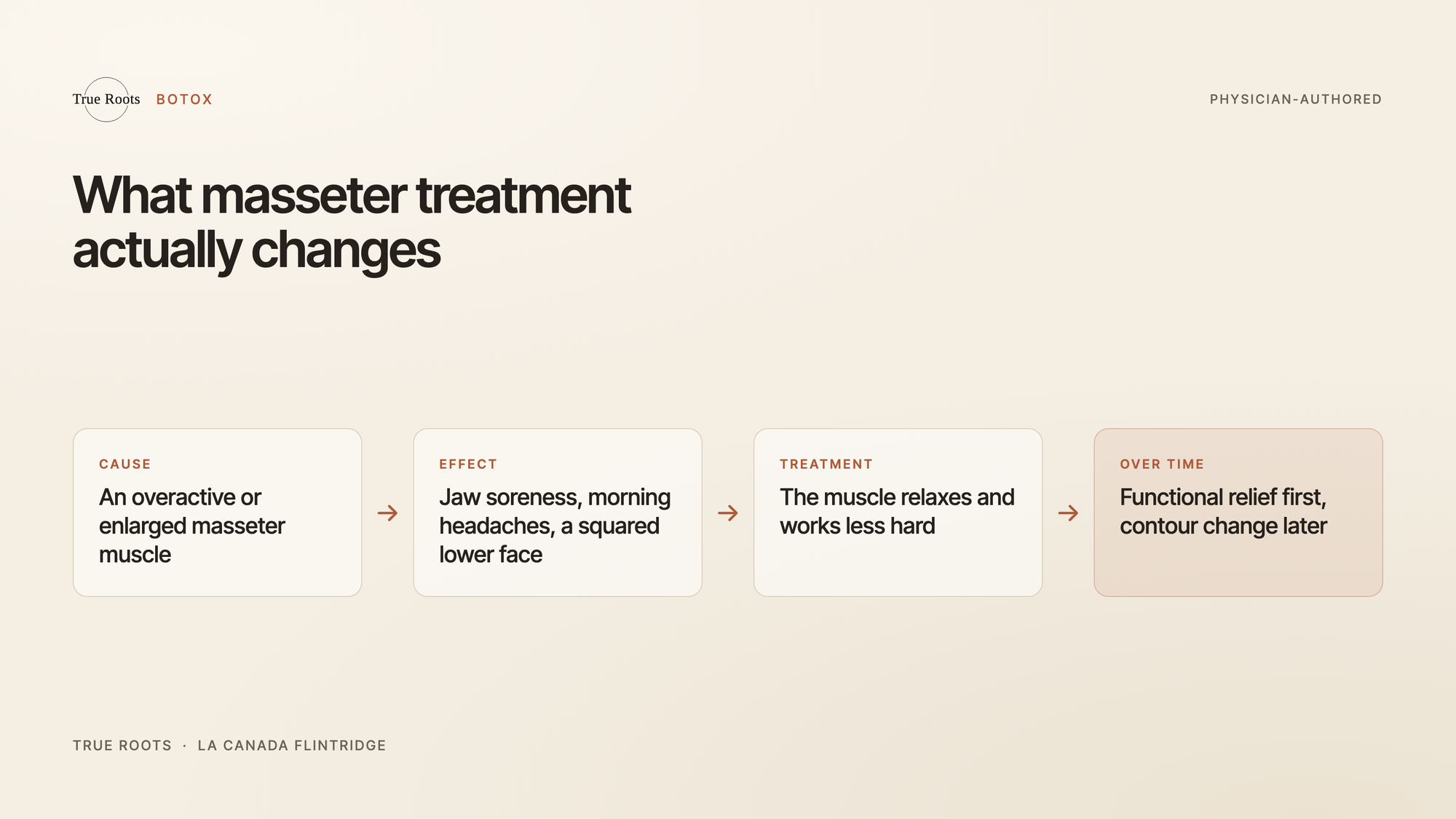
Masseter Botox injects a neuromodulator into the masseter, the thick chewing muscle at the jaw angle. Relaxing it reduces clenching force, which often eases jaw soreness and morning headaches, and over repeated treatments lets the muscle shrink and soften a squared lower face. It is an off-label use in the US. Results vary.
It is one of the fastest-growing neuromodulator requests, and the reason is structural: it sits exactly where a functional problem and an aesthetic one overlap.
What does the masseter muscle actually do?
The masseter runs from the cheekbone to the angle of the jaw and is one of the strongest muscles in the body by cross-sectional force. Its job is closing the jaw, and it does that job thousands of times a day without being asked.
Like any muscle under repeated load, it grows. A masseter that is clenched through the night and braced through a stressful workday hypertrophies the same way a trained calf does.
That hypertrophy produces two separate complaints in the same person. One is felt: soreness, tightness, and headaches that are worst on waking. The other is seen: a wider, squarer, bulkier lower face that no amount of skincare or weight loss changes.
Why does an overactive masseter cause jaw pain and headaches?
A muscle held under sustained tension for hours becomes sore, exactly like a shoulder held up all day. Overnight clenching keeps the masseter contracting through sleep, which is why the pain and the dull temple headache tend to peak in the morning.
The force involved is substantial enough to wear down tooth surfaces over years, which is often how people first find out they grind. Dentists frequently spot it before patients feel it.
Grinding and clenching are a diagnosis that belongs to a dentist or physician, not to an injector working from a photo. Relaxing the muscle addresses the force. It does not address why you are clenching, and that distinction matters.
How does the injection slim the jawline?
Botulinum toxin reduces the signal telling the muscle to contract fully. Less contraction means less use, and a muscle that is used less gradually loses bulk, the same principle as any muscle deconditioning.
This is why the aesthetic result is slow. There is nothing dissolved or removed. You are waiting on atrophy, and atrophy runs on its own schedule.
It also means candidacy matters. If your lower face is wide because of bone structure or buccal fat rather than muscle, relaxing the masseter will not deliver the contour change you are picturing. An honest assessment before treatment prevents an expensive disappointment.
What is the realistic timeline?
Functional relief almost always arrives before visible slimming. Most people notice they are clenching less, and that their jaw feels less tight, well before anyone comments on their face shape.
| What it does | Typical onset | Typical duration | What it does not do |
|---|---|---|---|
| Reduces clenching force and jaw muscle tension | Days to about 2 weeks | Around a few months, then maintenance | Diagnose or cure grinding, or fix its underlying cause |
| Eases muscular jaw soreness and morning tightness | Within the first few weeks | Follows the same cycle | Treat a true temporomandibular joint disorder |
| Softens a squared, bulky lower face | Weeks to months, gradually | Builds across repeated cycles | Narrow a face that is wide from bone or fat |
| Reduces the force behind tooth wear | Days to about 2 weeks | Follows the same cycle | Replace a dental night guard where one is indicated |
Visible contour change generally requires more than one treatment cycle. Anyone promising a slimmer jawline in a week is selling the wrong expectation.
How long does it last, and why is maintenance the norm?
The masseter is large, strong, and in constant use, and that combination tends to shorten the duration compared with smaller expression muscles. Expect the effect to fade over months rather than persist.
Maintenance is standard here, not a failure of the treatment. Some patients find that after several consistent cycles the muscle stays smaller with longer intervals between visits, though this varies considerably from person to person.
What about TMJ?
Be careful with this one, in both directions. Masseter injection can meaningfully help the muscular component of jaw tension, and for many people the muscle is the main source of what they are feeling.
A true temporomandibular joint disorder is different. It involves the joint, the disc, and sometimes the bite, and it deserves a dental or medical evaluation rather than an assumption. If your jaw locks, clicks painfully, or will not open fully, get the joint assessed first.
The same applies to severe grinding. A dental night guard protects the teeth in a way a neuromodulator does not, and the underlying driver, whether that is stress, sleep-disordered breathing, or a bite issue, is worth looking at directly.
What are the risks worth knowing?
Temporary chewing fatigue is the most common complaint, usually noticed on steak, bagels, or gum during the first few weeks. It resolves as the body adapts.
The risk that actually depends on your injector is anatomical. The masseter sits near muscles that control the corner of the mouth, and injections placed too superficially or too far forward can affect the smile. Correct depth, correct placement, correct dose. This is a procedure where anatomy knowledge is the whole game, which is the case for physician-led care generally and worth weighing when you choose a clinic.
Bruising and injection-site soreness can happen and are short-lived.
Is masseter Botox on track to become FDA-approved?
It might be soon, which would be a first. On August 4, 2026, the FDA accepted for review Allergan Aesthetics' supplemental application to add masseter muscle prominence as a Botox Cosmetic indication, supported by two positive Phase 3 trials (M21-416 and M21-417) that both met their primary endpoints. If cleared, Botox would become the first neurotoxin specifically FDA-approved for masseter muscle prominence in the US, and its fifth aesthetic indication overall.
Acceptance for review means the FDA agreed to evaluate the application. It is not an approval, and no decision date has been announced, so the honest present-tense answer is still "off-label" until that changes.
The underlying data already gives a clearer efficacy picture than "off-label" implies. A randomized Phase 2b study of 187 adults, published in JAAD, found a statistically significant reduction in masseter volume versus placebo at day 90 (p<.001), with roughly twice the patient satisfaction of placebo and no adverse effect on the mandible or teeth. That is the evidence base behind a use that is common in practice well ahead of the paperwork catching up.
Masseter Botox in La Canada Flintridge
True Roots Performance & Aesthetics is a practice in La Canada Flintridge, California, serving Pasadena, Glendale, and greater Los Angeles. Dr. Luis Valle, a board-certified physician, assesses whether your jaw complaint is muscular, whether your lower face width is muscle driven, and what a realistic plan looks like before anything is injected. Treatment planning and cost are confirmed at consultation.
If you are also weighing smaller-dose treatment elsewhere on the face, see baby Botox and starting early.
This article is educational and not a substitute for personalized medical advice.