
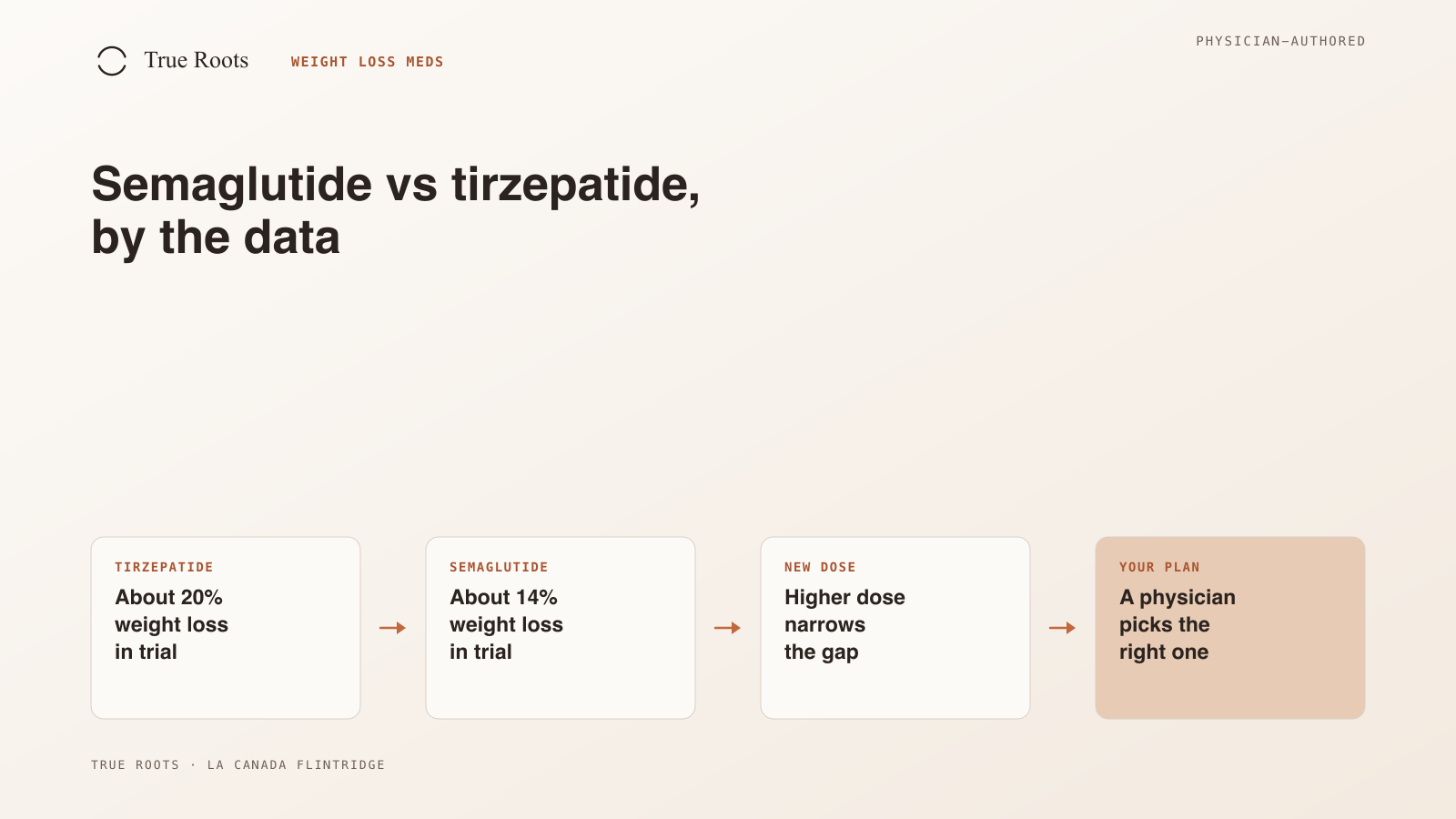
Semaglutide and tirzepatide are the two leading injectable weight loss medications, both physician-prescribed and both working by quieting appetite and slowing digestion. In the only head-to-head trial, SURMOUNT-5, tirzepatide produced about 20.2% average body-weight loss at 72 weeks versus 13.7% for semaglutide (NEJM 2025). Tirzepatide wins on the average, but semaglutide has the longer record and is often cheaper, so the right choice is individual. At True Roots in La Canada Flintridge, near Pasadena and Glendale, the entry point is a $300 Health Assessment with Dr. Valle, credited in full toward your program.
Semaglutide vs tirzepatide: what is the short answer?
Tirzepatide produced more weight loss on average in the head-to-head data, but "more on average" is not the whole decision. Semaglutide (Ozempic, Wegovy) activates one receptor pathway, GLP-1. Tirzepatide (Mounjaro, Zepbound) activates two, GLP-1 and GIP, and that dual action is the leading explanation for the larger average result. Both reduce appetite, both are weekly injections, and both are dosed up slowly to limit side effects. Which one is right depends on your history, your response, your tolerance, cost, and availability.
How much more weight does tirzepatide produce?
About 6.5 percentage points more on average in the head-to-head data. In SURMOUNT-5, the first large head-to-head trial, adults with obesity and without diabetes lost about 20.2% of body weight on tirzepatide versus 13.7% on semaglutide over 72 weeks, a relative difference of roughly 47% (NEJM 2025, via ACC). More tirzepatide patients also crossed the bigger thresholds: about 48% hit 20% or more weight loss versus 27% on semaglutide. One caveat worth knowing: the trial was open-label, meaning participants knew which drug they were taking, so read it as strong but not flawless evidence.
Does the new higher-dose semaglutide change this?
Partly, by narrowing the gap. In March 2026 the FDA approved a higher-dose semaglutide, Wegovy HD (7.2 mg), for adults who have already tolerated the standard 2.4 mg dose (FDA, 2026). In its STEP UP trial the higher dose produced about 18.7% weight loss on the treatment-regimen measure, which counts all randomized participants, and about 20.7% on the efficacy measure, which assumes people stay on the drug, both at 72 weeks (Novo Nordisk, 2025). Because this is not a head-to-head comparison with tirzepatide, treat cross-trial numbers as a rough guide rather than a verdict. The higher dose also carries a newly flagged altered-skin-sensation side effect that the FDA has said it is still investigating (FDA, 2026).
Which has fewer side effects?
Neither has a clear edge; both are dominated by gastrointestinal effects. Nausea, constipation, diarrhea, and reduced appetite are most noticeable when starting or raising the dose, and they usually improve as the body adjusts, with slow dose increases the main way to limit them. In SURMOUNT-5, more participants stopped semaglutide because of gastrointestinal side effects than stopped tirzepatide (NEJM 2025, via ACC). The honest takeaway is that tolerability is individual, and which one sits better with you is something only careful titration and monitoring reveal. See muscle loss on weight loss medications for a side effect people underestimate.
Is one cheaper than the other?
Usually semaglutide, which has been available longer. Branded weight loss medications carry high list prices, around $1,349 a month for Wegovy without insurance as of October 2026, though manufacturer self-pay programs run well below that and prices change often (NovoCare self-pay pricing). Access also shifts with regulation and supply. Because dose, plan, and what is included are individual, True Roots does not publish program or medication pricing; your physician sets that with you after evaluation. For the broader picture, see how medical weight loss is priced.
Which is right for me?
There is no universal winner, which is the answer most marketing pages avoid. Tirzepatide tends to suit people whose primary goal is maximum average weight loss and who tolerate it well. Semaglutide tends to suit people who value the longer track record, a lower cost, or who do not tolerate tirzepatide. For many, the practical path is starting on one, titrating slowly, and switching if response or tolerance calls for it. All of that turns on your medical history, contraindications, and how your body actually responds. To understand the drug class first, see how these weight loss medications work.
How does True Roots decide which one you get?
A weight loss medication is chosen the way any prescription should be: after a physician looks at you. Dr. Valle reviews your history, screens for contraindications, and, when a medication is appropriate, selects it, sets the starting dose, monitors you, and adjusts over time, inside a supervised plan that includes nutrition, protein, and activity guidance. This is a licensed, in-person medical practice, not an online order form. The entry point is a $300 Health Assessment, credited in full toward your program if you proceed.
This article is educational and not a substitute for personalized medical advice.