
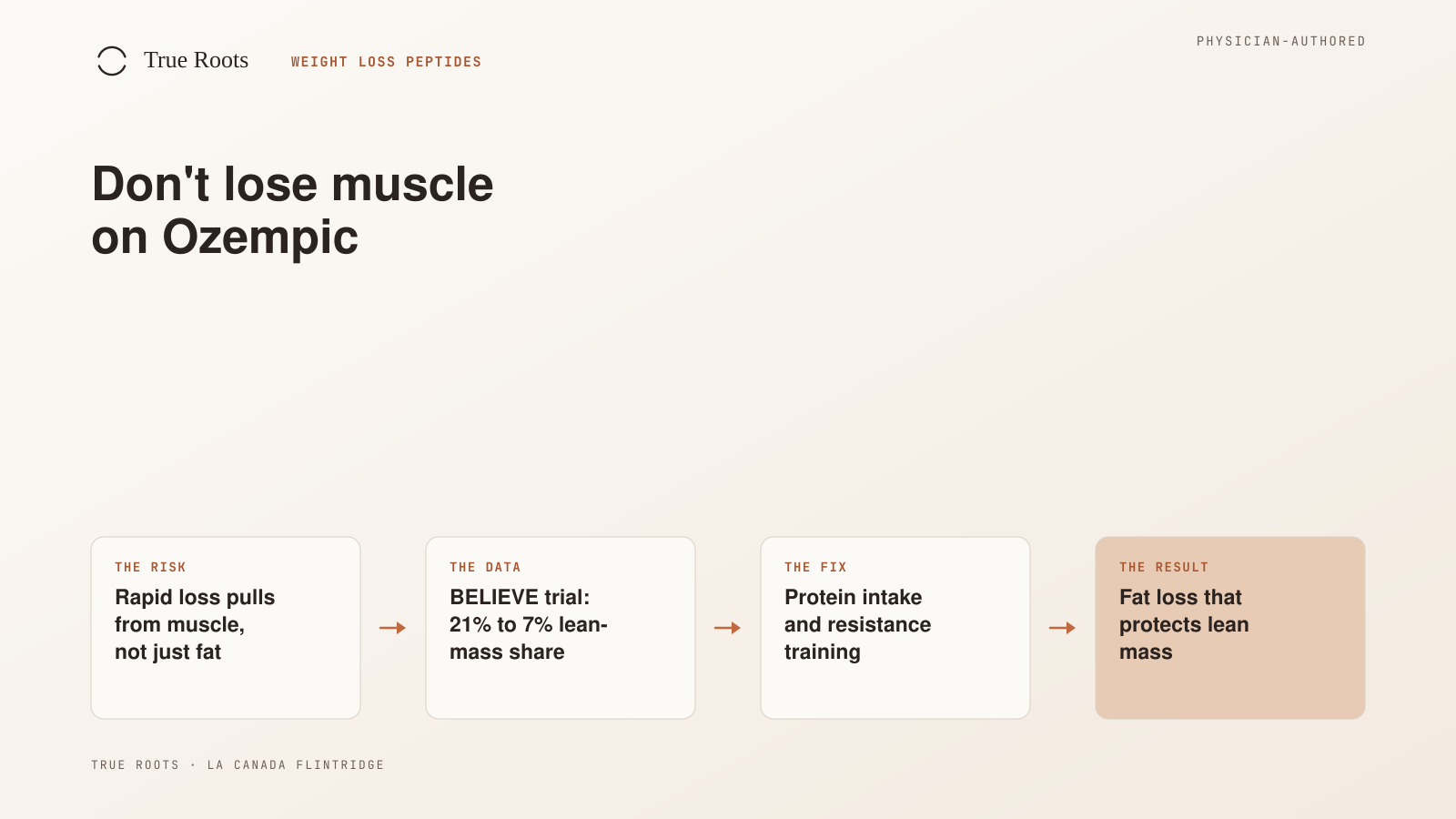
If you have started noticing you look thinner but somehow less toned, or that you feel weaker than the number on the scale would suggest, you are not imagining it. GLP-1 medications like semaglutide (Ozempic, Wegovy) and tirzepatide (Zepbound, Mounjaro) can take real muscle along with fat, and 2026 research has started to explain both why it happens and what actually reduces it.
Is muscle loss on GLP-1s real, or overstated?
It is real. Research presented at ENDO 2026 found that people taking GLP-1 or GLP-1/GIP medications became significantly less physically active, which matters because these drugs also reduce lean muscle mass, not fat alone. Less activity plus rapid overall weight loss is a combination that pulls disproportionately from muscle when nothing is done to counter it. This is not a reason to avoid GLP-1 therapy. It is a reason to treat muscle preservation as part of the plan, not an afterthought.
What actually changes the outcome
The most useful 2026 finding on this is that the muscle-to-fat ratio of weight loss is not fixed. The BELIEVE trial combined semaglutide with bimagrumab, an antibody that blocks activin and myostatin signaling, over 72 weeks, and cut the lean-mass share of total weight lost from roughly 21 percent down to about 7 percent. That result will not be available to most patients today, since bimagrumab is not part of a standard GLP-1 protocol, but it proves an important point: the ratio of muscle to fat lost is influenced by the protocol around the medication, not locked in by the drug itself.
A separate study of GLP-1 and GLP-1/GIP patients under close obesity-specialist supervision found minimal lean muscle loss, which supports the same conclusion from a different angle: monitoring and protocol quality drive the outcome as much as the medication class does. See how GLP-1 peptides work for weight loss for the full picture of how these medications function.
The three things that actually help
- Protein intake. Reduced appetite on a GLP-1 makes it easy to under-eat protein without noticing, and protein is the raw material muscle needs to be maintained during a calorie deficit. This is frequently the single biggest lever available to someone on these medications.
- Resistance training. Muscle that is being actively used and loaded is muscle your body is less likely to break down for energy during rapid weight loss. This does not require an elite training program, just consistent resistance work rather than relying on appetite suppression alone.
- Physician-supervised titration. Going up in dose too quickly, eating far too little because appetite has vanished, or skipping fundamentals like electrolytes and sleep are common patterns behind the worst outcomes reported on these medications. A monitored, gradual approach is not just about comfort. It is directly tied to how much lean mass gets preserved.
Why this matters especially if you already lift, or are TRT-adjacent
If you already train or are considering TRT alongside a weight-loss goal, muscle preservation on a GLP-1 is not a side note, it is central to the outcome you actually want. Losing 20 pounds that is one-fifth muscle looks very different in the mirror and on a strength chart than losing 20 pounds that is mostly fat. This is also why GLP-1 therapy and a monitored peptide or recovery stack are frequently discussed together in a physician-led plan rather than treated as separate, unrelated goals.
The bottom line
Muscle loss on Ozempic or Zepbound is a real, documented pattern, not an inevitability. Adequate protein, resistance training, and real physician supervision are the levers that change the ratio of what you actually lose. A GLP-1 medication is a tool inside a monitored plan, not a shortcut that replaces the fundamentals.
This article is educational and not a substitute for personalized medical advice.