
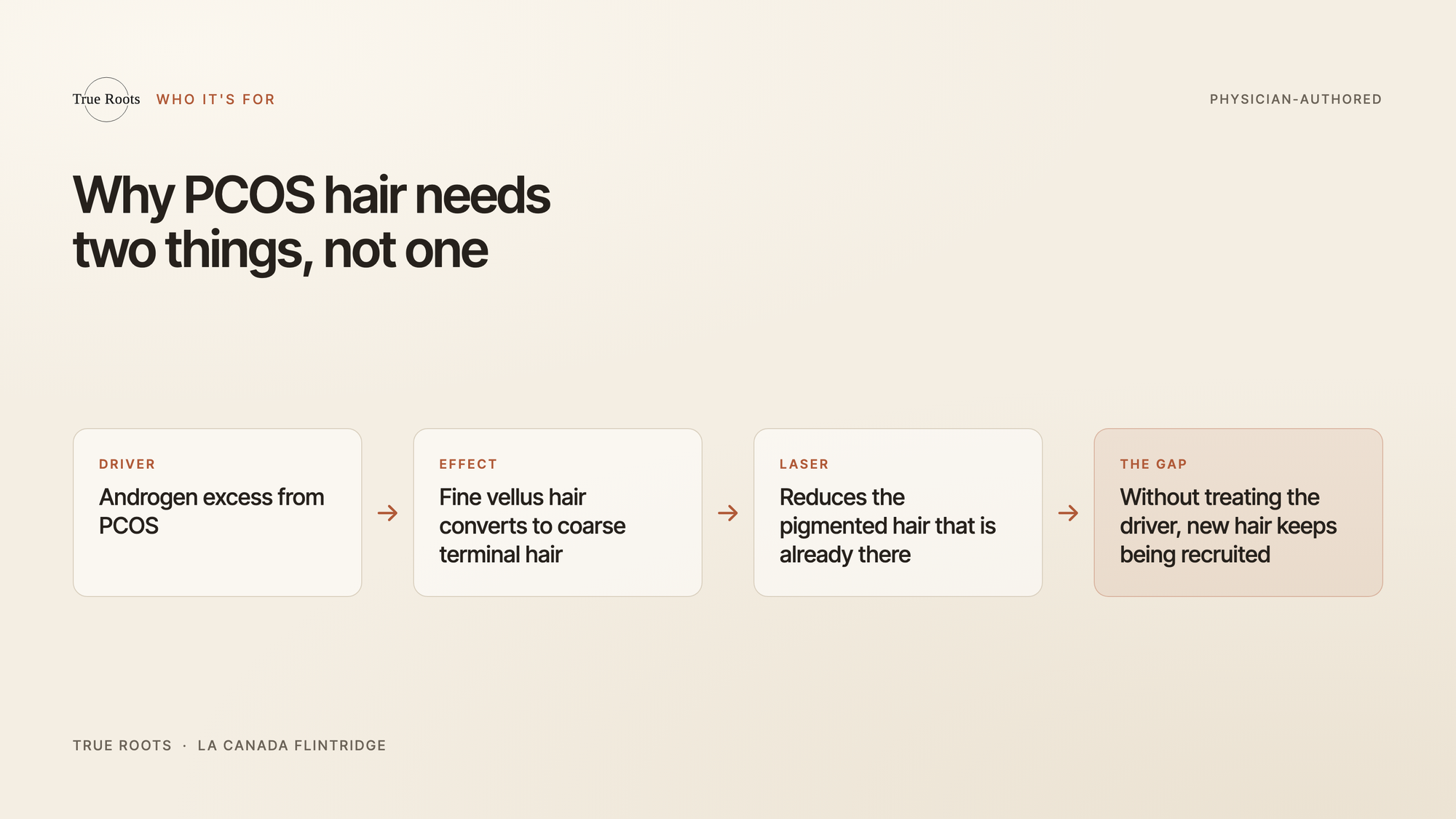
Laser hair removal genuinely reduces the coarse facial hair that PCOS produces, and it does not stop PCOS from producing more. Androgen excess keeps converting fine hair into coarse terminal hair, so expect more sessions than a woman without PCOS and expect ongoing maintenance rather than a finish line. That is the condition, not a failure of the laser.
Why does PCOS cause coarse facial hair?
Every hair follicle on your face is already there. Most of them produce vellus hair, the fine, pale, barely visible kind that covers most of the body.
In polycystic ovary syndrome, elevated androgens act on follicles in androgen-sensitive regions and convert vellus hair into terminal hair: thicker, darker, longer, and firmly anchored. The pattern follows a predictable map, which is why it shows up on the chin and jawline, upper lip, sides of the neck, chest, around the areola, and along the lower abdomen.
This is hirsutism, and it is one of the most common reasons women with PCOS seek treatment. It is also driven by follicle sensitivity, not just hormone level, which is why two women with similar labs can have very different amounts of hair.
What does laser actually do about it?
Laser hair removal works by selective photothermolysis. Melanin in the hair shaft and follicle absorbs the light, converts it to heat, and that heat disables the follicle's ability to produce hair.
For pigmented terminal hair, this works well. The coarse dark hairs that bother you most are the ones the laser targets best.
Because it only affects hair in the anagen (growth) phase, a course is required for anyone. Coarse androgen-driven hair on the face adds to that count. Your provider spaces sessions to catch successive growth cycles, and adjusts based on what you report about regrowth between visits.
Why does PCOS hair come back when other people's does not?
Because the driver is still running.
Laser disables treated follicles. It does not change the hormonal environment that made those follicles produce terminal hair in the first place. In PCOS, that environment persists, and follicles that were producing vellus hair last year can be recruited into producing terminal hair next year.
So the honest expectation is: a strong reduction from the initial course, then maintenance sessions at whatever interval keeps you where you want to be. Many women find that interval stretches out over time. It rarely disappears.
Clinics that promise you a permanent end date are either not asking about PCOS or not telling you the truth. We would rather say it now than have you feel misled at session ten.
What will laser not fix?
Laser needs pigment. White, grey, and very light blonde hairs have no meaningful melanin for the laser to target, so they do not respond, at any setting, on any device.
This matters for PCOS specifically, because the mix on the chin and jaw often includes some unpigmented hairs, and that mix increases with age.
For those hairs, electrolysis is genuinely the better tool. It destroys the follicle with an electrical current delivered through a fine probe, hair by hair, and it works regardless of color. The tradeoff is real: one comparison found alexandrite laser was substantially faster, less painful, and more reliable than electrolysis for pigmented hair, while electrolysis retains the advantage of working on all hair colors.
A common and sensible sequence is laser first to clear the bulk of the pigmented hair, then electrolysis for whatever remains.
Laser, electrolysis, or hormonal treatment?
| Approach | What it does | Best for | Limitation |
|---|---|---|---|
| Laser hair removal | Heats melanin in the hair to disable the follicle, treating many hairs per pass | Coarse, dark, pigmented hair over larger areas such as chin, jaw, neck, chest, abdomen | Needs pigment, so white, grey, and very light hair do not respond. Does not address the hormonal driver |
| Electrolysis | Destroys individual follicles with an electrical current through a fine probe | White, grey, blonde, and red hairs, and small stubborn patches after laser | Hair by hair, so slower and generally more uncomfortable over large areas |
| Hormonal management | Addresses the androgen excess recruiting new terminal hairs | Reducing how much new coarse hair develops over time | Does not remove hair already present. Requires medical evaluation and monitoring |
The table is the whole argument for combining them. Each one covers the other's gap.
Why combining laser with hormonal care produces the durable result
If you only treat the hair, you are running against a driver that keeps producing more. If you only treat the hormones, the coarse hair already on your chin stays there, because medical management slows new recruitment rather than removing existing terminal hair.
Doing both is what makes the result hold. Laser clears what exists, medical management reduces what is coming, and the maintenance interval gets longer instead of shorter.
True Roots offers hormone evaluation with Dr. Luis Valle as a separate service, so the hormonal side can be assessed here rather than sending you elsewhere. If hormones are new territory for you, hormonal hair loss in women covers how androgens act on hair on the scalp as well.
The part nobody writes about
Facial hair is one of the most distressing symptoms of PCOS, and the daily management of it (plucking before work, checking your jaw in the car mirror, avoiding certain lighting) costs more than the hair does.
You are not vain for treating it and you are not failing at anything by needing maintenance. It is a hormonal condition with a visible symptom, and both parts are treatable.
What you should expect from a provider is a straight answer about how many sessions, what will not respond, and what maintenance looks like. Not reassurance.
Where to start
True Roots Performance & Aesthetics is in La Canada Flintridge, serving Glendale, Pasadena, and the greater Los Angeles area. Laser hair removal is performed on the Lumenis Splendor X by a licensed nurse practitioner who is physician-trained and Lumenis-certified, with wavelength selected for your skin type, which matters if you are Fitzpatrick III to V (see laser hair removal for dark skin). See current laser pricing, or read what to expect from treatment and how laser hair removal works first.
This article is educational and not a substitute for personalized medical advice.