
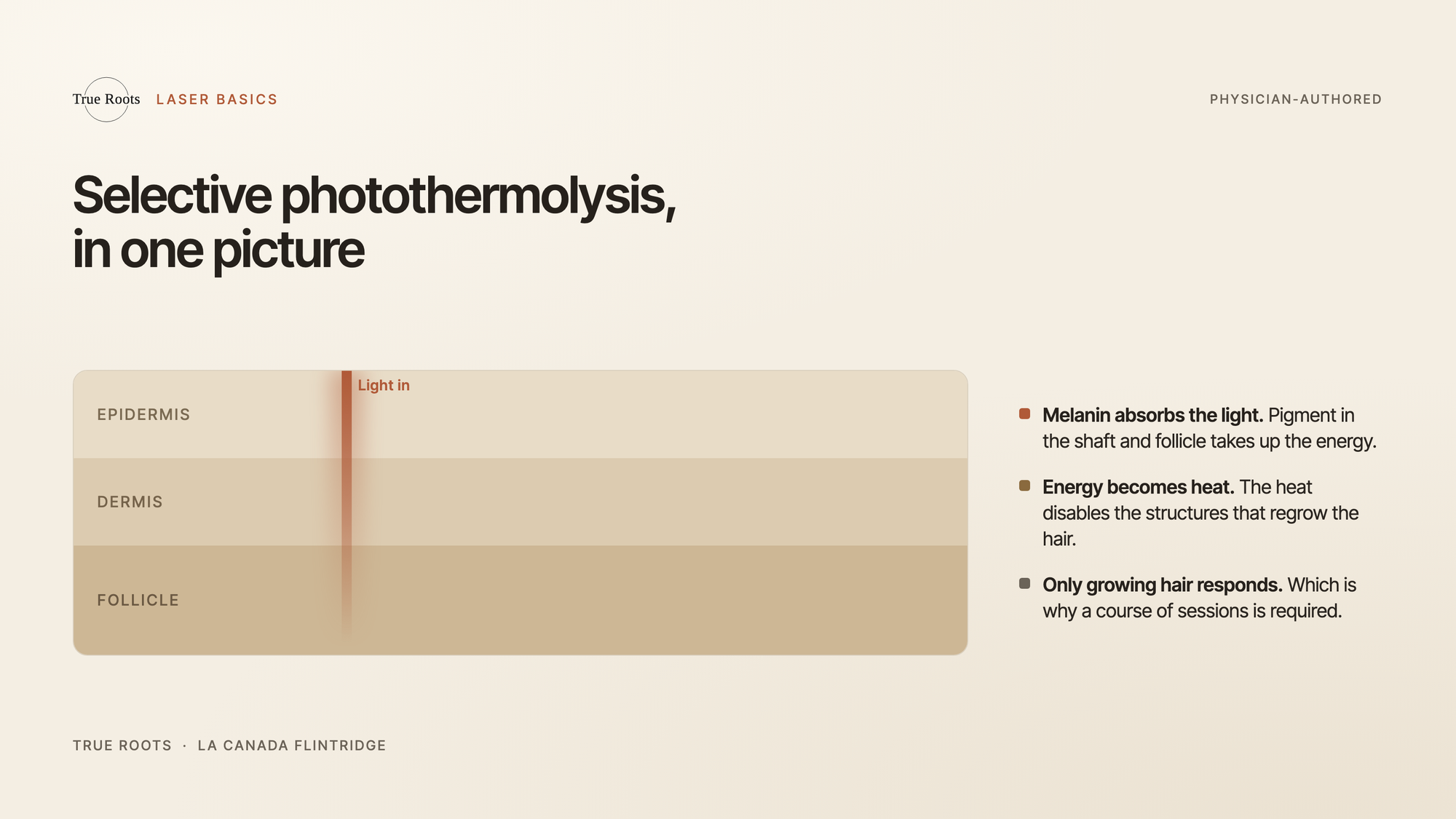
Laser hair removal works by selective photothermolysis. Melanin in the hair shaft absorbs the laser's light and converts it to heat, damaging the follicle's regenerative structures. Only hairs in the active growth phase respond, which is why it takes a course of sessions rather than one visit. The honest outcome is permanent hair reduction, not total removal.
What is selective photothermolysis?
Selective photothermolysis is the principle behind every hair removal laser. The device emits a wavelength of light that melanin absorbs far more readily than the surrounding tissue does.
Melanin sits in the hair shaft and in the follicle below it. When it absorbs the pulse, that light energy becomes heat.
The heat travels a short distance into the follicle and damages the structures responsible for regrowing hair: the bulb and the bulge region where the follicle's stem cells live. Damage those and the follicle either stops producing hair or produces something finer and lighter.
"Selective" is the load-bearing word. The pulse is timed so heat builds inside the pigmented hair faster than it can spread into the skin around it. That timing is what protects the surrounding tissue.
It also explains why contrast matters. The more pigment there is in the hair relative to the skin, the easier it is to hit the target and spare everything else. How modern devices handle deeper skin tones is covered in laser hair removal on dark skin.
Why does laser hair removal take more than one session?
Because hair does not grow on a single schedule. Every follicle cycles independently through three phases, and the laser only does real work in one of them.
| Phase | What the follicle is doing | Does the laser work? |
|---|---|---|
| Anagen (active growth) | Hair is attached to the bulb and dense with melanin | Yes. This is the phase that responds |
| Catagen (transition) | The follicle regresses and pulls away from its blood supply | Poorly. The pigmented target is retreating |
| Telogen (rest and shed) | The hair sits loose or has already fallen out | No. There is nothing meaningful to heat |
At any given moment only a fraction of the hair in an area is in anagen, and that fraction varies by body region. Facial and underarm hair cycles faster than leg or back hair.
So one session treats the hairs that happened to be growing that day. Spacing sessions weeks apart lets the next wave of follicles enter anagen and become treatable. That is the whole logic of a course, and it is why nobody can honestly sell a one-visit result.
Is laser hair removal permanent?
The term recognized by the FDA is permanent hair reduction, not permanent hair removal. The difference is worth understanding before you buy anything.
Permanent hair reduction means a long-term, stable decrease in the number of hairs that regrow, measured well after a treatment course is complete. It does not mean every follicle in the area is gone forever.
What most people actually get is a large drop in density, with whatever remains growing back finer, lighter, and slower. Many are satisfied enough to stop there. Others come back occasionally for maintenance.
A clinic promising that every hair will be gone permanently is either using the word loosely or overselling. Results vary by person, and saying so builds more trust than the pitch does.
What actually determines your result?
Four variables do most of the work.
Hair color and coarseness. The laser needs pigment. Dark, coarse hair absorbs energy best. White, grey, and very light blonde hair carries too little melanin to heat, and no device on the market changes that. Red and very fine hair responds unpredictably.
Skin tone. Melanin in the epidermis competes with melanin in the hair for the same light. Older single-wavelength systems handled that competition badly, which is why deeper skin tones were historically either avoided or treated at settings too conservative to work. Longer wavelengths and adjustable blends changed the math.
The device. Wavelength, spot size, pulse duration, and cooling set how much energy can be delivered safely in one pass. Laser vs IPL vs diode walks through those differences.
The operator's settings. The same machine in two sets of hands produces two different outcomes. Fluence, pulse width, and wavelength blend should be selected for your skin and hair, then adjusted as the course progresses. A tunable device only helps if somebody is actually tuning it.
Why does hair grow back for some people?
Because hair growth is hormonally driven, and a laser treats follicles, not endocrinology.
PCOS, thyroid disorders, insulin resistance, and certain medications keep signaling follicles to produce terminal hair. Laser can reduce what is present now, but ongoing hormonal stimulation can recruit follicles that were previously dormant.
That does not make laser a poor choice in those cases. It usually means planning for more sessions up front and a realistic maintenance schedule after. See laser hair removal for PCOS and hirsutism.
What does a full course look like?
Most areas are planned as a series of sessions roughly 4 to 6 weeks apart, with the interval set by how quickly that body region cycles. Faster areas like the face come back sooner. Legs and backs stretch longer.
Session counts vary more than marketing suggests. One published series in skin of color reported a mean of about 8.9 treatments, with a range from 4 to 22, which is a useful reminder that any single number is an average hiding a wide spread.
You should see shedding start within one to three weeks of the first session, and visible thinning after two or three sessions. Judge the result at the end of the course, not in the middle. For the practical version of a visit, see your first laser hair removal session.
Where this gets done, and on what
True Roots Performance & Aesthetics is in La Canada Flintridge and treats patients from Pasadena, Glendale, and across greater Los Angeles. Laser hair removal here is performed on the Lumenis Splendor X, a dual-wavelength system, by a licensed nurse practitioner who is physician-trained and Lumenis-certified.
The hardware matters more than most clinics bother to explain. Inside Splendor X breaks down the two wavelengths, the square spot, and the power behind them.
This article is educational and not a substitute for personalized medical advice.