
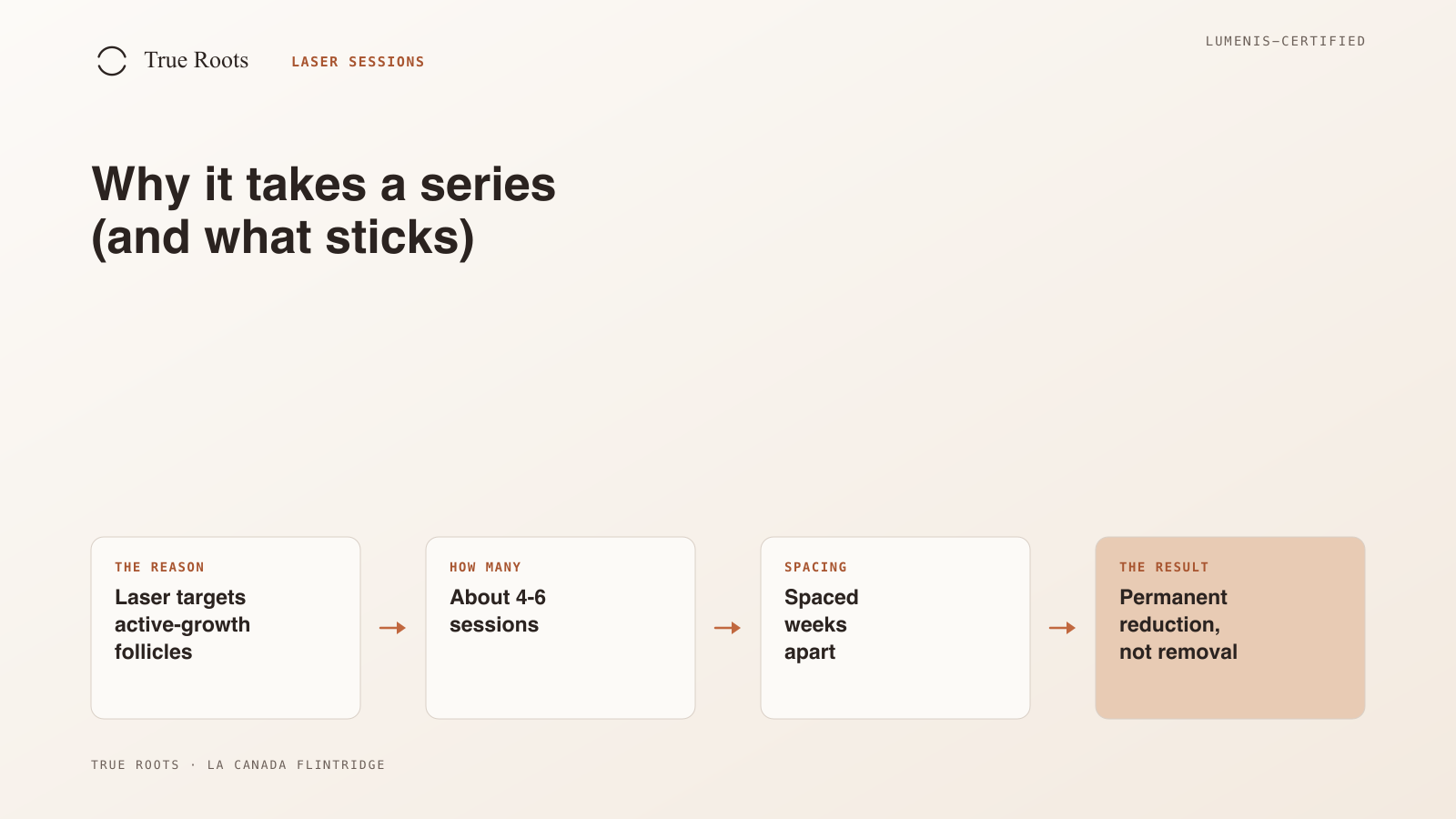
Most areas need a series of laser hair removal sessions, not one, because the laser only disables a follicle while it is in its active growth phase, and at any time only a share of your hair is in that phase. Most people need about 4 to 8 sessions, usually spaced several weeks apart, according to the Mayo Clinic. At True Roots in La Cañada Flintridge, near Pasadena and Glendale, treatments use the Lumenis Splendor X, and most areas run about 4 to 6 sessions. The result is best described as permanent hair reduction, a lasting, stable drop in the number of hairs, not permanent removal.
How many sessions will I need?
Plan for a series, about 4 to 8 sessions for most people, usually spaced several weeks apart (Mayo Clinic). At True Roots most areas run about 4 to 6 sessions on the Splendor X.
The exact number is personal. Hair color and coarseness, skin tone, the body area, and hormonal drivers all move it, which is why your provider sets the plan at session one rather than quoting a flat number up front. The Splendor X is tunable between two wavelengths, 755 nm and 1064 nm, so settings can be matched to your hair and skin rather than forcing one compromise.
Why does it take multiple sessions (the growth-cycle reason)?
Because your hair is not all growing at once. Each follicle cycles through an active growth phase (anagen), a transition phase, and a resting phase, and the laser can only disable a follicle that is actively growing and full of pigment when the pulse hits it.
At any single appointment, only a fraction of the follicles in an area are in that targetable phase. The resting ones are invisible to the laser that day. Spacing sessions apart lets a new batch of follicles cycle into the growth phase, so each visit catches a different share of your hair. That is the entire reason one session cannot do the job.
Is laser hair removal permanent?
It is permanent hair reduction, not permanent removal, and the distinction is honest. The Mayo Clinic notes that laser greatly reduces hair growth but does not guarantee hair will never grow back, and that results last several months and sometimes years.
Regulators use the term permanent hair reduction to mean a lasting, stable reduction in the number of hairs, and the hair that does grow back tends to be finer, lighter, and sparser. Any promise of permanent removal with zero regrowth goes beyond what the technology is cleared to do. That is also why some people need the occasional touch-up, particularly where hormones keep reactivating follicles.
How far apart are sessions spaced?
Typically about 4 to 8 weeks, depending on the area. The interval tracks how fast a region cycles its hair.
Facial and underarm hair returns faster and is generally spaced more tightly, while legs, backs, and chests cycle more slowly and are spaced further apart. Going back too soon does not speed up your results; it wastes a session on follicles that have not yet re-entered the growth phase the laser can act on. Your provider sets the spacing for each area.
Does the number of sessions change by body area or hair color?
Yes, on both counts. Here is the general pattern:
| Factor | Effect on session count |
|---|---|
| Dark, coarse hair on correct settings | Responds well, often within a typical course |
| Gray, white, or very light blonde hair | Little pigment to target, poor candidate |
| Face, chin, upper lip (often hormonal) | Can need more sessions plus periodic maintenance |
| Legs, underarms, backs, chests | Usually within the typical range, spaced further apart |
| Hormonal conditions like PCOS | Can extend the course and require ongoing maintenance |
Hair color matters because the laser targets pigment. Skin tone matters for settings and safety, not for whether it works: the 1064 nm Nd:YAG wavelength passes epidermal melanin more safely than shorter wavelengths, which is why it is used for deeper skin tones (Fitzpatrick IV to VI). If you have PCOS or hormone-driven growth, laser for PCOS and hirsutism covers what to expect.
Is it worth it versus shaving or waxing long-term?
For most people with pigmented hair who are tired of the endless cycle, yes, over the long run. Shaving and waxing are recurring costs in time and money, while a laser course is a finite series that leaves you with far less hair and far less upkeep.
It is not worthwhile for everyone. If your hair is gray, white, or very light blonde, the laser has little to target, and you are better served saving the money. And if you are not willing to complete a full course spaced over several months, you will not see the result the series is designed to deliver. The honest version of "is it worth it" depends on your hair type and your follow-through, not on a slogan.
Who is a good fit, and who is not?
A good fit: pigmented (dark) hair, a willingness to complete a series over several months, and a goal of lasting reduction rather than a single quick fix. The common LA areas, underarms, bikini, legs, and face, all fit this well.
Not a good fit: very light, gray, or white hair with minimal pigment, or anyone expecting one session to be the end of it. A straight assessment at session one will tell you honestly if laser is not your answer before you commit to a course.
What the plan looks like at True Roots
True Roots Performance & Aesthetics is in La Cañada Flintridge, California, serving Pasadena, Glendale, and greater Los Angeles. Sessions use the Lumenis Splendor X and are NP-administered, physician-trained, and Lumenis-certified. Most areas run about 4 to 6 sessions, spaced to your area, and True Roots sells 5-packs by area and books single sessions for touch-ups. A 5-pack covers most or all of a typical course for many areas. For the full per-area rates, see how much laser hair removal costs in LA; to understand the device, see inside the Splendor X; and for prep and aftercare, see what to expect at your first session.
This article is educational and not a substitute for personalized medical advice.