
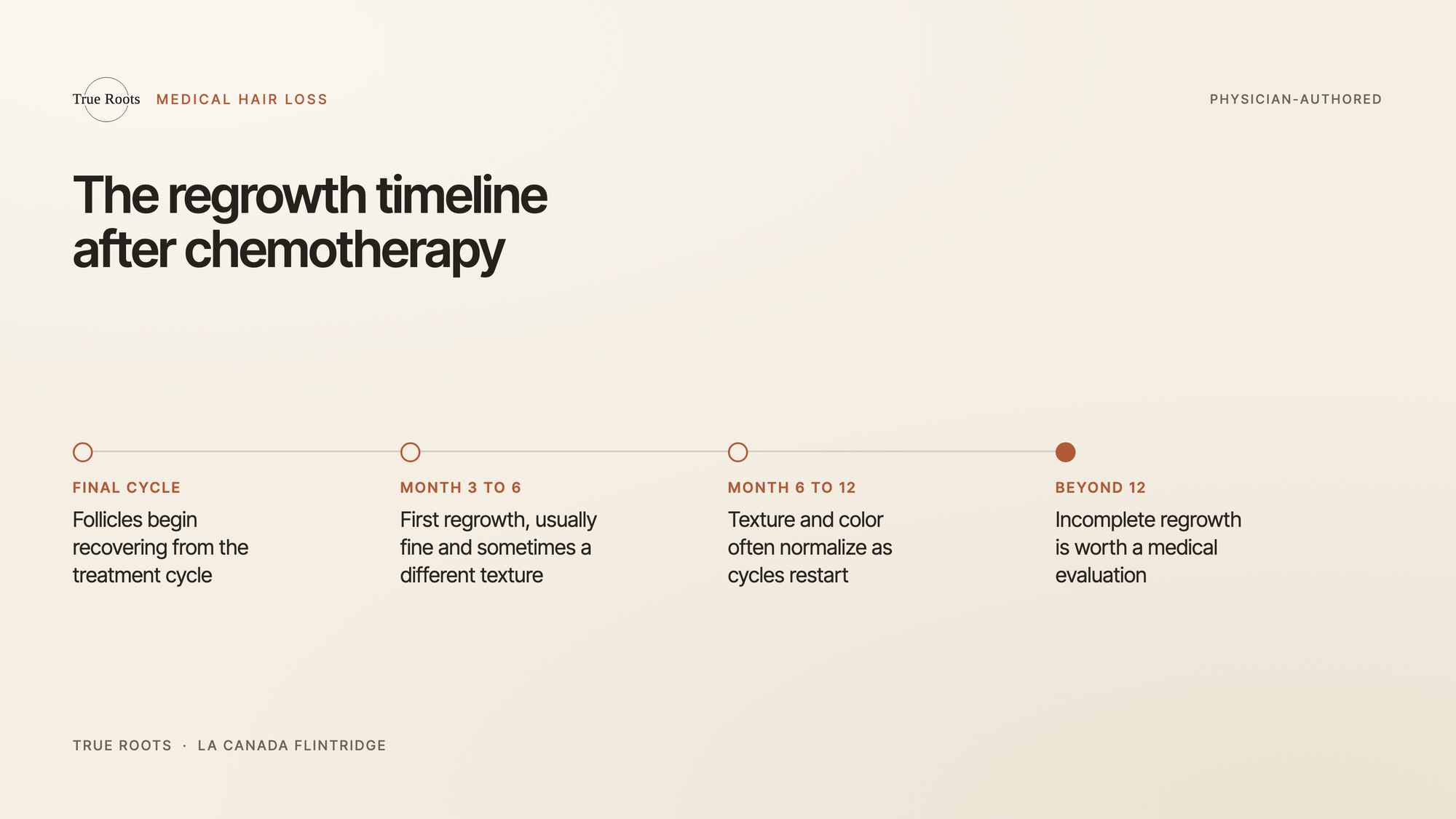
Most chemotherapy-induced hair loss is reversible. Regrowth typically begins within about three to six months of the last cycle, often returning first as fine, sometimes differently textured hair that normalizes over a year or more. The follicles are not scarred. When regrowth is still incomplete six months out, that is worth evaluating rather than waiting on.
When does hair grow back after chemotherapy?
Some people feel soft fuzz on the scalp within a few weeks of the final cycle. More commonly, visible regrowth arrives in the three to six month window afterward.
From there it is a long, unglamorous process. The first hairs are fine and sparse. Length accumulates at roughly half an inch a month, so a short style is realistic around six to nine months and normal texture usually takes a year or more.
Timelines differ by regimen, by dose, and by person. Regrowth after a taxane-based regimen is well documented to be slower and less complete for some patients than after other agents.
| Time since last cycle | What is commonly seen |
|---|---|
| 0 to 3 months | Scalp bare or soft downy fuzz appearing |
| 3 to 6 months | Fine regrowth becomes visible, often uneven across the scalp |
| 6 to 12 months | Enough length for a short style; texture and color may still look unfamiliar |
| 12 to 24 months | Texture and pigment usually normalize; density continues improving |
| Past 6 months with little regrowth | Worth evaluating for persistent chemotherapy-induced alopecia |
Why is my hair growing back curly, finer, or grey?
The phenomenon is common enough to have a nickname: chemo curl. Hair returns with a different wave pattern, a finer caliber, or less pigment than before.
Chemotherapy acts on rapidly dividing cells, which includes the cells that shape the hair fiber and the ones that produce pigment. While those recover, the fiber they build is not quite the one they used to build.
For most people this settles over the following year. Some keep a permanently different texture, which is a cosmetic outcome rather than a medical problem.
What is persistent chemotherapy-induced alopecia?
Persistent chemotherapy-induced alopecia (pCIA) describes incomplete regrowth six months or more after finishing treatment. It can look like overall reduced density, thinning concentrated on the crown, or patchy areas that never filled in.
It has historically been quoted at somewhere between 1 and 15 percent of patients, but current understanding is that it is more common than that range implies. It is most often reported after taxane-based regimens.
Endocrine therapy afterward is part of the picture too. Tamoxifen and aromatase inhibitors lower estrogen availability, and that can drive androgen-pattern thinning on top of whatever the chemotherapy did. Those are two different problems with two different answers, which is exactly why an evaluation is worth more than a product.
Other contributors deserve a look at the same time: iron stores, thyroid function, vitamin D, and B12 are all commonly disrupted through a cancer treatment course, and all are correctable. See hair loss blood tests. A separate telogen effluvium from surgery, illness, or medication changes can also layer on top and does resolve on its own.
What treatments have published support?
Nothing here is a guarantee, and the evidence base is modest. These are the options with actual published data behind them.
Minoxidil, topical or low-dose oral. The most studied. A retrospective cohort of 119 patients with persistent chemotherapy-induced alopecia reported improvement in 74 percent after a median of about 105 days of treatment. A separate retrospective cohort of 51 patients reported improvement or stability at three to six months. Retrospective studies are useful signal, not proof of effect, and individual responses vary.
Spironolactone. In one published series, spironolactone alone or combined with minoxidil produced moderate or significant improvement in roughly 60 percent of patients. It is a prescription medication with its own considerations, and in breast cancer survivors specifically it should be discussed with your oncologist.
Correcting deficiencies. Less exciting and frequently overlooked. Low ferritin or an unaddressed thyroid problem will limit any other treatment you try.
Where do lasers fit, honestly?
This is the part where a clinic can easily overstate things, so we will be precise.
Fractional laser research for hair regrowth is genuinely promising, but the human evidence sits mainly in androgenetic alopecia and alopecia areata. The work specific to chemotherapy-induced hair loss is largely preclinical, in animal models, not human trials.
FoLix is a 1565 nm non-ablative fractional Er:Glass laser, FDA-cleared to improve the appearance of scalp hair in adults with androgenetic alopecia. It is not cleared for chemotherapy-related hair loss, and it is not a treatment for cancer-related hair loss.
Where it can reasonably come up is narrow: a survivor, well past active treatment, with persistent pattern-type thinning that has been properly evaluated. In that situation it is an individualized, off-label discussion between you and a physician, weighed against minoxidil and the other options above, with no promise attached. We do not treat patients during active chemotherapy.
Bring your oncologist into the decision
This is not a formality. Before any elective scalp treatment, get written clearance from your oncology team.
Your oncologist knows your regimen, your current endocrine therapy, your platelet and healing status, and whether the timing makes sense at all. A responsible clinic will ask for that clearance before it books you, and will wait if the answer is not yet.
That posture is what physician-led care is supposed to mean: the medical picture leads, and the treatment decision follows it.
If you want an evaluation
True Roots Performance & Aesthetics is in La Canada Flintridge, serving Pasadena, Glendale, and greater Los Angeles. Hair restoration is physician-led by Dr. Luis Valle, a board-certified physician. For a survivor whose regrowth has stalled, a visit here is an evaluation and a set of labs, coordinated with your oncologist, with a plain answer about what is worth trying and what is not.
This article is educational and not a substitute for personalized medical advice.