
The honest answer is that peptide safety and legality both depend almost entirely on the specific peptide and how you obtain it. Peptides have exploded in popularity, hyped on one side by influencers and affiliate sellers and supplied on the other by an unregulated gray market of online vials. The honest middle path is neither extreme: the right peptide for your goal, properly sourced, with a physician selecting, dosing, and monitoring. A few peptides, such as certain GLP-1 medications, are FDA-approved. Many performance and longevity peptides are sold as research-use-only and are not approved for human use. When a peptide is selected, dosed, and monitored by a physician using US-made, third-party-tested product, it is generally well tolerated. When the same molecule comes from an anonymous vial bought online with no testing or oversight, the safety and legal picture changes dramatically. At True Roots in La Canada Flintridge, peptide therapy is physician-led by board-certified Dr. Luis Valle, which is the difference that makes it both safer and more accountable.
Are peptides legal?
The legal status of peptides is not one-size-fits-all. It comes down to the peptide and the source:
- FDA-approved peptide medications, such as certain GLP-1 medications, are legal and regulated when used under a physician's care.
- Research-use-only peptides are the category most performance and longevity peptides fall into. They are not approved for self-directed human use, which is precisely why source quality (US-made, cGMP, third-party tested, with a certificate of analysis) and physician selection, dosing, and monitoring are what make them safe.
- Anonymous vials bought online for self-administration are untested and unaccountable. There is no certificate of analysis, no oversight, and no one verifying what is in the vial, which is where the real legal and medical risk lives.
The dividing line is accountability. Going through a physician who uses a verified, third-party-tested source is the responsible route. Ordering anonymous, untested vials off a website is not.
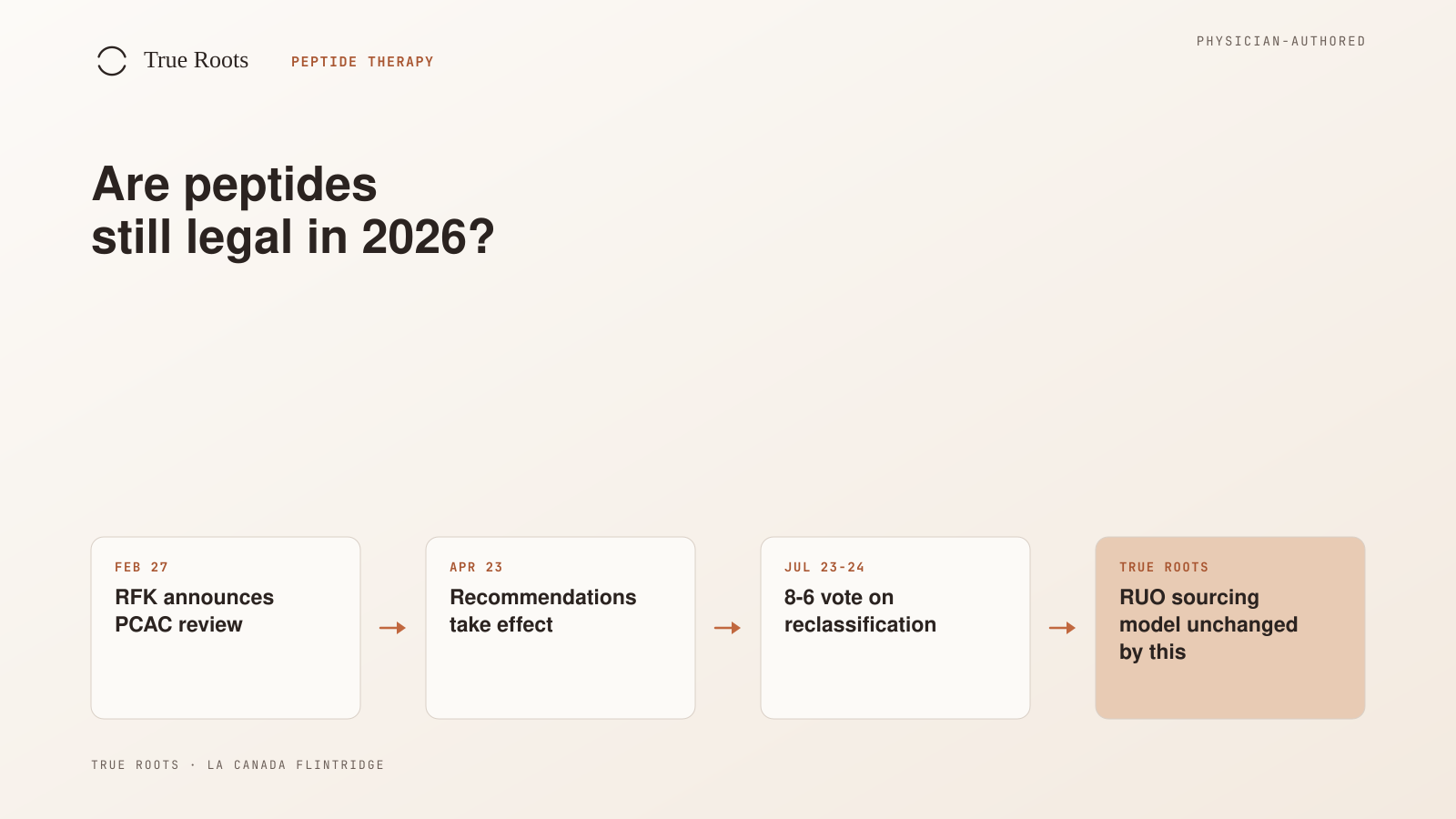
One reason this category feels confusing is that the rules genuinely move, and 2026 has been an unusually active year for this specific story. On Feb 27, 2026, HHS Secretary RFK Jr. announced that roughly 14 of 19 peptides then on the FDA's restricted compounding list, including BPC-157, TB-500, CJC-1295, Ipamorelin, and others, would move back to a category that compounding pharmacies can work with under a prescription, with that change reported to take effect around April 23, 2026. That reclassification is not FDA approval: it does not create validated indications, standardized dosing, or established safety and efficacy data. The FDA's own Pharmacy Compounding Advisory Committee then held a formal public meeting July 23-24, 2026 and voted 8-6 in favor of adding BPC-157 to the official compounding bulks list, along with several other peptides. A committee vote is a recommendation, not final FDA action, and as of this writing no final rule has been confirmed.
None of this changes how True Roots sources or uses peptides. This story is specifically about the compounding-pharmacy pathway. True Roots' peptides come through a different channel entirely, research-use-only product from a US-made, cGMP, third-party-tested supplier, never a compounding pharmacy, and Dr. Valle does not "prescribe" them in the pharmacy sense. On top of the federal story, state medical boards set their own rules, and for telehealth the law that applies is the one in the state where the patient is located. Keeping current on all of this is exactly the kind of thing a physician handles so you do not have to.
Are peptides FDA approved?
Some are, many are not, and the distinction matters. A handful of peptides are FDA-approved medications for specific conditions, such as GLP-1 drugs used for weight loss and diabetes (see GLP-1 peptides for weight loss). Many peptides popular in performance and longevity circles are not FDA-approved for those uses and are sold as research-use-only. A physician can tell you the current status of a specific peptide and, when appropriate, source it through a verified, US-made, third-party-tested channel for your goal.
Are peptides safe?
When selected, dosed, and monitored by a physician using quality, third-party-tested product, peptides are generally well tolerated, and side effects tend to be mild and dose-related. Safety drops sharply, though, with anonymous vials bought online, and it is worth being blunt about why:
- Purity is unreliable. Untested products may contain contaminants or be mislabeled.
- Dosing is unreliable. The actual amount in the vial may not match the label.
- Contents may differ from the claim. You may not be getting what you think.
- No oversight. Without screening and monitoring, risks go unmanaged.
This is why sourcing quality and supervision are the two biggest safety factors in peptide therapy. The molecule may be the same; the safety is not.
What are the side effects of peptides?
Side effects vary by peptide, but common ones are mild and manageable: injection-site redness or irritation, temporary water retention, flushing, lightheadedness, or, with certain peptides, changes in appetite or blood sugar. Growth-hormone-related peptides can cause water retention or tingling at higher doses, and GLP-1 peptides commonly cause nausea early on. A physician screens for risks before starting, chooses appropriate dosing, and monitors you, which keeps side effects manageable and catches anything concerning early. For background on how peptides act, see what are peptides.
The safe, accountable way to use peptides
If peptide therapy interests you, the safe and responsible path is straightforward:
- Start with a physician consultation to define your goal and review your health.
- Use peptides selected by that physician, sourced from a US-made, third-party-tested supplier with a certificate of analysis.
- Follow proper dosing and a defined protocol, not internet folklore.
- Get monitored, with follow-up and any relevant bloodwork.
For a fuller walkthrough of how to take peptides safely, including how to tell real human evidence from hype, see our dedicated guide.
At True Roots, that looks concrete: our peptides are US-made in cGMP facilities, third-party tested to over 98% purity with certificates of analysis available, and selected, dosed, and monitored by Dr. Valle.
Avoid the shortcut of buying anonymous vials online for self-use. It removes every safeguard that makes peptide therapy reasonable in the first place, and it carries both health and legal risk. To understand what a proper protocol involves, see peptide therapy cost.
This article is educational and not a substitute for personalized medical advice.